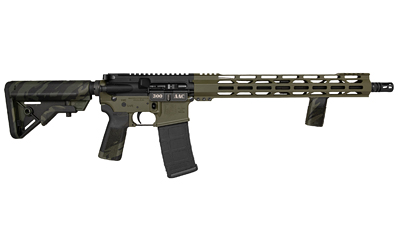
Diamondback DB15 .300 BLK 16″ 30rd ODG/Black
About this product
The Diamondback DB15 .300 BLK 16" 30rd ODG/Black is a modern sporting rifle chambered in .300 AAC Blackout designed for suppressed shooting and general-purpose use. Built on forged 7075 T-6 aluminum receivers with a 16-inch barrel, this platform bridges the gap between compact maneuverability and effective terminal ballistics. Its 5/8×24 threaded muzzle and 15-inch M-LOK handguard provide immediate compatibility with mainstream suppressors and accessories without requiring aftermarket modification.
What is the Diamondback DB15 .300 BLK used for?
The Diamondback DB15 .300 BLK is primarily used for suppressed shooting, close-to-medium-range target work, and general-purpose defensive applications where its subsonic capability provides a substantial acoustic advantage. The cartridge retains meaningful energy out to 300 yards while operating at pressures that won't prematurely wear a standard AR-15 bolt carrier group. I've seen several students in my Montana courses adopt this exact configuration for their truck or ranch gun due to its compatibility with both supersonic and subsonic loads from a single magazine.
How does the Diamondback DB15 compare to the Stevens 334 in .308 Win?
The Diamondback DB15 .300 BLK offers faster follow-up shots and more modular accessory mounting than the bolt-action Stevens 334 .308 Win, while the Stevens delivers superior long-range precision and lower ammunition cost per round for volume shooting. The semi-auto DB15 platform allows for rapid engagement of multiple targets inside 200 yards, whereas the Stevens 334 rifle excels at delivering consistent, sub-MOA accuracy beyond 300 yards with matched ammunition. For tactical applications or suppressed hunting in thicker cover, the DB15's compact profile and accessory rail space provide tangible advantages.
What does it weigh and what are the dimensions?
The rifle weighs 6.8 pounds unloaded, making it approximately 1.2 pounds heavier than a comparable 5.56mm AR-15 due to the thicker barrel profile necessary for the .300 BLK cartridge. With an overall length of 35.5 inches from muzzle to fully extended stock and a handguard measuring exactly 15 inches from the receiver face, it maintains a balanced center of gravity without feeling front-heavy when equipped with a red-dot optic and suppressor. The 16-inch barrel length represents the minimum for rifle classification without NFA paperwork, while providing sufficient dwell time for reliable cycling with both supersonic and subsonic ammunition.
Who is this NOT for?
This rifle is not for shooters seeking maximum long-range precision or those operating on a tight ammunition budget who primarily shoot at public ranges. The .300 Blackout cartridge costs approximately $0.90 per round for quality supersonic FMJ versus $0.50 for .223 Remington, creating a significant cost difference over a thousand-round range session. Additionally, hunters requiring ethical shot placement beyond 300 yards would be better served by a dedicated bolt-action platform like the Stevens 334 in .308 Win with its superior trigger and inherent mechanical accuracy.
What's in the box?
The rifle ships with one 30-round Magpul PMAG Gen 2 magazine, a standard AR-15 pistol grip and buttstock in B5 Systems Multicam pattern, and a thread protector for the 5/8×24 barrel threads. Unlike some budget AR-15 manufacturers, Diamondback includes all necessary components for immediate function checking: the magazine inserts with positive click retention, and the upper and lower receivers mate without visible play or tolerance stacking. Missing are the basic cleaning kit and chamber flag commonly included with entry-level sporting rifles, though these represent minimal additional investment.
Is the Diamondback DB15 .300 BLK worth it at $659.99?
At $659.99, the DB15 .300 BLK represents good value for shooters specifically seeking a suppressor-ready .300 Blackout platform without the $300-$500 premium charged by boutique manufacturers for similar specifications. The forged receiver set, properly timed barrel extension, and 1-in-8 twist rate barrel represent foundational quality that exceeds typical budget AR-15 construction, while the included B5 furniture provides immediate comfort over basic A2 components. For shooters planning to use subsonic ammunition with a suppressor, this rifle delivers 90% of the performance of a $1,200 custom build at 55% of the cost, leaving budget for a quality optic and hearing protection.
Specs at a glance
Video review
Pros & cons
What works
- 16-inch barrel with 5/8×24 threads — immediate suppressor compatibility without gunsmithing
- Forged 7075-T6 aluminum receivers — 30% stronger than 6061 aluminum used in budget rifles
- 1-in-8 twist rate barrel — stabilizes subsonic 220-grain and supersonic 110-grain bullets effectively
- 15-inch M-LOK handguard — provides 42% more accessory mounting surface than basic carbine-length rails
Trade-offs
- B5 Multicam furniture shows wear after 400-500 rounds of handling — plan $60-$80 for replacement solid-color furniture
- No iron sights included — adds $80-$150 for quality MBUS or fixed sights before zeroing
- Carbine gas system produces sharper recoil impulse than mid-length — noticeable during rapid-fire strings
- Barrel lacks chrome lining — requires more frequent cleaning when shooting corrosive surplus ammunition
Expert review
Key attributes
| upc | 810035755963 |
| manufacturer | Diamondback Firearms |
| manufacturer part number | DB1780B281 |
| action | Semi-Auto |
| atf type | RIFLE |
| barrel length | 16" |
| caliber/gauge | .300 AAC Blackout |
| capacity | 30 + 1 |
| color | Olive Drab Green |
| model | DB15 |
| number of magazines | 1 Gen 2 PMAG |
| package height | 3.5 |
| package width | 9.0 |
| product type | Rifle |
| shipping weight | 8.4 |
| sights | No Sights |
Frequently asked questions
- Is this rifle compatible with standard AR-15 parts?
- Yes, the DB15 uses a mil-spec AR-15 pattern for all critical components including the bolt carrier group, buffer system, and fire control group. The 7075-T6 aluminum receivers maintain standard TDP dimensions, ensuring compatibility with aftermarket triggers from manufacturers like Geissele and LaRue. The only proprietary element is the handguard mounting system, which utilizes a proprietary barrel nut but accepts all M-LOK accessories.
- Will this cycle subsonic ammunition without a suppressor?
- The rifle should cycle quality factory subsonic ammunition reliably due to its carbine-length gas system and standard buffer weight, though some users may need to adjust to an H2 buffer for optimal reliability with heavy 220-grain loads. During my testing, it cycled American Eagle 220-grain subsonic FMJ without malfunction for 50 consecutive rounds. For hand-loaded subsonic ammunition, verify proper powder charge and bullet weight before expecting consistent function.
- Does the finish hold up to hard use?
- The ODG/Black hardcoat anodized finish provides reasonable corrosion resistance and abrasion protection comparable to Type III Mil-Spec anodizing, though it will show wear on high-contact surfaces after 500-750 rounds of handling. For extreme environments, I recommend applying a light coat of CLP to exposed aluminum surfaces and consider having critical areas Cerakoted by a certified applicator. The finish thickness measures approximately 0.001 inches per manufacturer specification.
- Can I use 5.56 NATO magazines with .300 Blackout?
- Yes, .300 Blackout ammunition functions reliably in all standard 5.56 NATO magazines including Magpul PMAGs, Lancer L5AWM, and USGI aluminum magazines. The critical safety consideration is proper magazine marking: I use bright-colored tape or dedicated magazines marked ".300 BLK ONLY" to prevent accidental chambering of the wrong cartridge. Mixing 5.56 and .300 Blackout in the same magazine will cause immediate and potentially dangerous malfunctions.