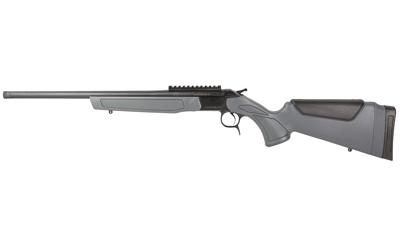
CVA Scout V3 .223 Rem 20in Threaded Blued/Grey
About this product
What is the CVA Scout V3 .223 Rem 20-inch Threaded Blued/Grey rifle? It is a modernized single-shot break-action rifle purpose-built for suppressor-ready hunting and regulatory-focused shooting. This platform pairs a straightforward mechanical design with critical features for modern accessories, namely a 5/8×24-threaded barrel and a factory-mounted Picatinny rail. Its 6.4-pound synthetic-stocked build prioritizes field portability and quick deployment from a pack over high-volume fire.
What is the CVA Scout V3 used for?
The Scout V3 is a specialized tool for hunters and trainers who operate in suppressor-friendly jurisdictions and value mechanical simplicity above all else. Its single-shot action forces deliberate shot placement, making it ideal for varmint control, introductory marksmanship training, and hunting in areas with magazine restrictions. The 20-inch 1:9-twist barrel and .223 Rem/5.56 NATO chambering provide effective terminal performance on small to medium game out to approximately 250 yards when paired with appropriate ammunition.
How does the CVA Scout V3 compare to the Stevens 334?
The CVA Scout V3 and the Stevens 334 bolt-action are fundamentally different platforms. The Stevens 334 is objectively better for any scenario requiring a follow-up shot, featuring a 4-round detachable box magazine and a faster manual of arms. I recommend the Scout V3 only when its specific advantages—namely its 2.1 pounds lighter weight (6.4 lbs vs. ~8.5 lbs for the .308 Stevens) and its suppressor-ready threading—outweigh the critical limitation of being a single-shot. For general-purpose hunting, the Stevens 334's repeater design is superior.
What does it weigh and what are the dimensions?
The rifle weighs 6.4 pounds (approximately 102.4 ounces) without an optic or suppressor. Its overall length is approximately 38.5 inches, with a 20-inch barrel. The action width at its widest point (the breech) measures 1.8 inches, allowing it to fit into compact scabbards and cases designed for takedown rifles. This compact package, combined with the synthetic stock's ambidextrous design, makes it a highly portable backcountry suppressor host.
Who is this NOT for?
This rifle is not for any shooter whose primary use case involves rapid engagement of multiple targets or high-volume range sessions. The single-shot break-action design introduces a mandatory 4 to 6-second reload cycle for even a practiced shooter, a fatal flaw in tactical training or competitive environments. It is also a poor choice for precision long-range shooting beyond 300 yards, as the 1:9 twist rate limits optimal stabilization to bullets under 62 grains.
What's in the box?
The factory package includes the rifle, a thread protector for the 5/8×24 muzzle threads, and a basic owner's manual outlining takedown and maintenance procedures. Do not expect scope bases, rings, sling swivels, or a case; CVA ships this as a bare-bones tool. The included thread protector is a basic steel unit that should be replaced with a quality muzzle device or suppressor mount before serious use to protect the critical 11-degree target crown.
Is the CVA Scout V3 worth it at $397.99?
At $397.99, the Scout V3 offers fair value strictly for its intended niche: as a lightweight, suppressor-host platform for deliberate hunting. You are paying for the simplicity of the forged and heat-treated break-action, the cost of threading the barrel, and the integrated Picatinny rail. If your needs align perfectly with that description, it's a justifiable expense. If you foresee needing a second shot quickly, spend an extra $50 on a bolt-action like the Stevens 334 and accept the weight penalty for vastly increased capability.
Specs at a glance
Video review
Pros & cons
What works
- Suppressor-ready with 5/8x24 threads — no gunsmithing required for legal NFA host setup.
- Weighs 6.4 lbs — 2.1 lbs lighter than a comparable bolt-action Stevens 334 rifle.
- Integrated 0-slot Picatinny rail — eliminates the need and cost for a separate base (saves ~$30-60).
- Break-action simplifies cleaning — entire bore is accessible with a single 36-inch rod in under 60 seconds.
Trade-offs
- Single-shot action only — imposes a 4-6 second minimum reload cycle, eliminating rapid follow-up shots.
- 1:9 twist rate limits bullet selection — optimally stabilizes bullets under 62 grains, hampering long-range heavy-projectile use.
- Blued finish offers minimal corrosion resistance — requires diligent oiling in wet environments compared to coated alternatives.
- No iron sights included — mandates an optics purchase and zeroing before first use, adding $100+ to initial cost.
Expert review
Key attributes
| upc | 043125144341 |
| manufacturer | Connecticut Valley Arms / CVA |
| manufacturer part number | CR4434 |
| action | Single Shot |
| atf type | RIFLE |
| barrel length | 20" |
| caliber/gauge | .223 REM/5.56 NATO |
| capacity | 1 |
| color | Black, Gray |
| length | 43.9500 |
| model | Scout |
| package height | 2.85 |
| package width | 7.75 |
| product type | Rifle |
| shipping weight | 8.35 |
| sights | No |
Frequently asked questions
- Is the barrel threading compatible with a 1/2x28 muzzle device?
- No, it is not directly compatible. The CVA Scout V3 features a 5/8x24 thread pitch, which is the standard for .30 caliber rifles. To mount a common .223/5.56 muzzle device with 1/2x28 threads, you will need a thread adapter from a reputable manufacturer like SilencerCo or Dead Air, adding approximately $40-60 and 0.8 inches of length to the muzzle.
- Does the Picatinny rail accept a standard AR-style scope mount?
- Yes, the 0-slot Picatinny rail (MIL-STD-1913) is machined directly into the receiver and will accept any commercial scope mount or red dot base designed for that standard. I recommend using a one-piece mount with a recoil lug, such as those from Warne or Leupold, to ensure zero retention over hundreds of break-action cycles.
- Can I shoot 5.56 NATO ammunition in this .223 Rem chamber?
- Yes, but with a critical caveat. The chamber is stamped .223 Remington, which has slightly different pressure specifications than 5.56 NATO. While modern rifles are generally robust, you should only use 5.56 mil-spec ammo from reputable manufacturers and monitor for excessive pressure signs. For consistent, safe performance, I stick with .223 Rem factory loads from Federal or Hornady in this rifle.
- How long does shipping to an FFL take?
- For Ironclad Armory, standard processing and ground shipping to a licensed dealer typically takes 5 to 7 business days from order confirmation. All firearms shipments require a valid FFL on file before processing begins; have your chosen dealer email their license to [email protected] to avoid delays.