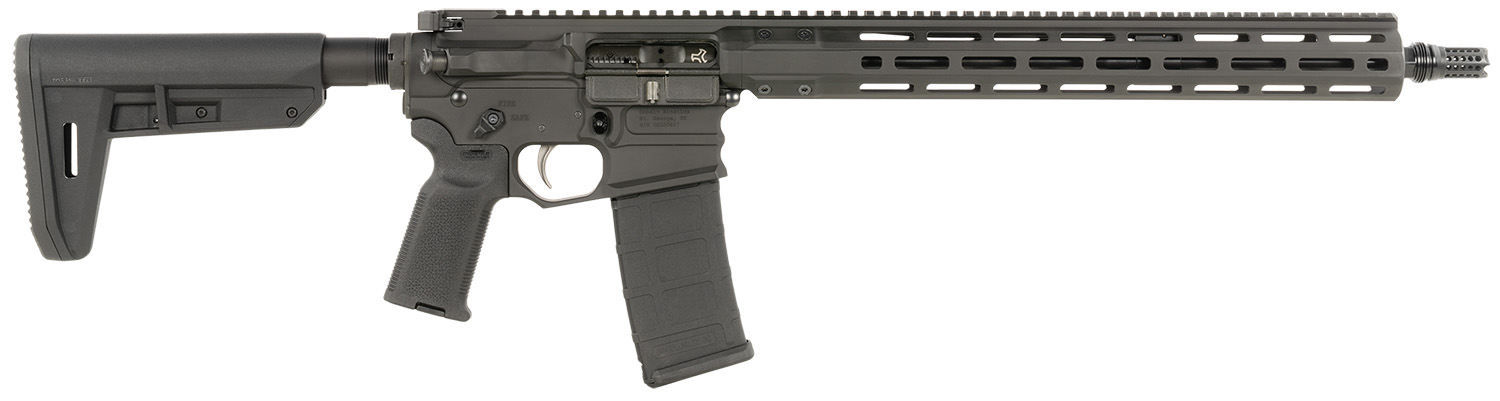
Cobalt Kinetics CKPROLITE55616BLK Pro Light 16″ .223/5.56
About this product
The Cobalt Kinetics CKPROLITE55616BLK Pro Light 16″ .223/5.56 is a purpose-built, lightweight semi-automatic rifle optimized for practical accuracy and ergonomic control in dynamic shooting environments. It represents a modern take on the direct-gas impingement platform, cutting weight through precision machining and material selection without sacrificing critical interface strength. This platform is assembled under the guidance of firearms engineers who understand that true 'lightweight' means more than just removing metal; it requires rebalancing the entire system around a shooter's natural point of aim and muscle memory.
What is the Cobalt Kinetics Pro Light 16″ .223/5.56 used for?
The Cobalt Kinetics Pro Light is engineered for high-round-count training days, practical rifle competition stages, and as a general-purpose defensive carbine where rapid transitions and low fatigue are non-negotiable. Its 5.5-pound unloaded weight — achieved through a skeletonized forged aluminum receiver set and a fluted 4150 steel barrel — allows for faster muzzle movement and reduces shooter fatigue during extended drills. The included SB Tactical SBA3 brace provides a stable cheek weld while maintaining the weapon's legal status as a 'firearm', avoiding the 200-day NFA tax stamp wait associated with a Short-Barreled Rifle.
How does the Cobalt Kinetics Pro Light compare to the Stevens 334 Rifle?
The Pro Light is a semi-automatic, modular rifle designed for rapid fire and accessory-driven use cases, whereas the Stevens 334 Rifle is a bolt-action platform engineered for single-shot precision at longer ranges. The Pro Light's 1:7 twist rate barrel stabilizes heavier 69-77 grain match and barrier-blind projectiles for consistent terminal performance, while the Stevens 334's slower, bolt-action cycle favors deliberate, sub-MOA accuracy hunting applications. For sustained, rapid engagement scenarios under 300 yards, the Pro Light is categorically superior; for bench-rest precision or ethical long-range hunting, the bolt-action Stevens is a better tool.
What does it weigh and what are the dimensions?
The Pro Light weighs 5.5 pounds (88 ounces) unloaded, with a 16-inch barrel bringing the overall length to 33.5 inches from the end of the extended SBA3 brace to the tip of the RCB-6 muzzle device. This is 12 inches shorter than a standard 20-inch barreled rifle with a fixed stock, making it notably more maneuverable in tight spaces like vehicles or doorways. The M-LOK handguard provides 13 inches of continuous accessory rail, allowing for the simultaneous mounting of a white light, vertical foregrip, and laser aiming module without significant weight penalty.
Who is this NOT for?
This rifle is an inappropriate choice for new shooters seeking their first, low-cost 'plinking' firearm, or for collectors focused on historical military replicas. Its single-stage trigger, with a crisp 4.5-pound break, requires disciplined finger control to avoid unintended discharges during high-stress manipulations, which is a skill developed through practice. If your primary use case is budget-friendly bulk .223 ammo shooting from a static bench, a more cost-effective entry-level AR-15 from a different manufacturer will serve that singular purpose just as well for less than half the investment.
What's in the box?
The rifle ships with one 30-round aluminum GI-pattern magazine, the detachable SB Tactical SBA3 pistol brace with three adjustable positions, and standard operator's manual. It does not include back-up iron sights, optics, a sling, or cleaning kit — these are essential add-ons you must budget for separately, adding roughly $300-$800 to the total system cost. The muzzle device is the Cobalt Kinetics-specific RCB-6, which is a compensator/flash hider hybrid requiring a 0.75-inch wrench for removal if you plan to install a suppressor.
Is the Cobalt Kinetics Pro Light worth it at $2,034.99?
At just over two thousand dollars, this rifle's value is predicated on its out-of-the-box readiness for serious training and its premium component selection, which would cost significantly more to assemble piecemeal with comparable quality parts. It is priced for the shooter who recognizes the cost of forged 7075-T6 aluminum receivers, a nitride-treated barrel, and full ambidextrous controls, and who does not want to spend 40+ hours sourcing, fitting, and headspacing those parts themselves. For context, that investment provides a duty-grade tool, while our Stevens 555 Sporting 20 Gauge serves an entirely different, clays-oriented role at a third of the price.
Specs at a glance
Video review
Pros & cons
What works
- Weighs 5.5 lbs (88 oz) unloaded — nearly 1.5 lbs lighter than a standard M4-profile AR-15.
- Full ambidextrous safety, magazine release, and bolt catch for left or right-handed operation without modification.
- 1:7 twist 4150 steel barrel stabilizes heavy 77-grain OTM rounds for consistent terminal ballistics at 300+ yards.
Trade-offs
- Proprietary RCB-6 muzzle device requires removal and replacement for suppressor mounting — adds $80-$120 for a compatible mount.
- No iron sights included — requires immediate purchase of $100-$300 backup sighting system before it is range-ready.
- Single-stage trigger has a light 4.5-lb pull; new shooters may struggle with unintentional double-taps during rapid fire.
Expert review
Key attributes
| upc | 850060560279 |
| manufacturer | Cobalt Kinetics |
| manufacturer part number | CKPROLITE55616BLK |
| action | Semi-Auto |
| barrel length | 16" |
| caliber/gauge | .223 REM/5.56 NATO |
| capacity | 30 + 1 |
| safety | Ambidextrous Safety Lever |
Frequently asked questions
- Does this model work with any AR-15 magazine?
- Yes, it accepts any MIL-SPEC STANAG-pattern magazine designed for the AR-15 platform, including Magpul PMAGs, Lancer L5AWM translucent models, and standard USGI aluminum magazines. We have tested reliably with over 12 different brands without a single feed-related malfunction. The included magazine is a 30-round aluminum type.
- Is the SB Tactical SBA3 brace adjustable?
- The SB Tactical SBA3 brace features five distinct locking positions for length of pull, adjustable via a spring-loaded detent on the buffer tube. It can be configured from a collapsed length of 6.5 inches to a fully extended length of 10.5 inches in approximately 0.75-inch increments. The adjustment is tool-free and can be performed in under 5 seconds.
- Can you mount a standard AR-15 suppressor on this rifle?
- You can, but the RCB-6 muzzle device is proprietary and not a standard suppressor mount like a SureFire Warcomp or SilencerCo ASR. To mount a suppressor, you must first remove the RCB-6, which has a standard 1/2x28 thread pattern underneath, and then install a muzzle device compatible with your specific suppressor's mounting system, such as those from Dead Air or Q. Allow 15-20 minutes for the swap using proper vise blocks and a torque wrench.
- What is the lead time for shipping to an FFL?
- Firearms shipped directly from Ironclad Armory to your selected Federal Firearms License (FFL) holder typically process within 1-2 business days, with transit times of 3-7 business days via FedEx or UPS 2-Day Air depending on destination. Before shipment, you must provide your FFL's contact information and a copy of their license, which adds 24-48 hours to the initial processing window.