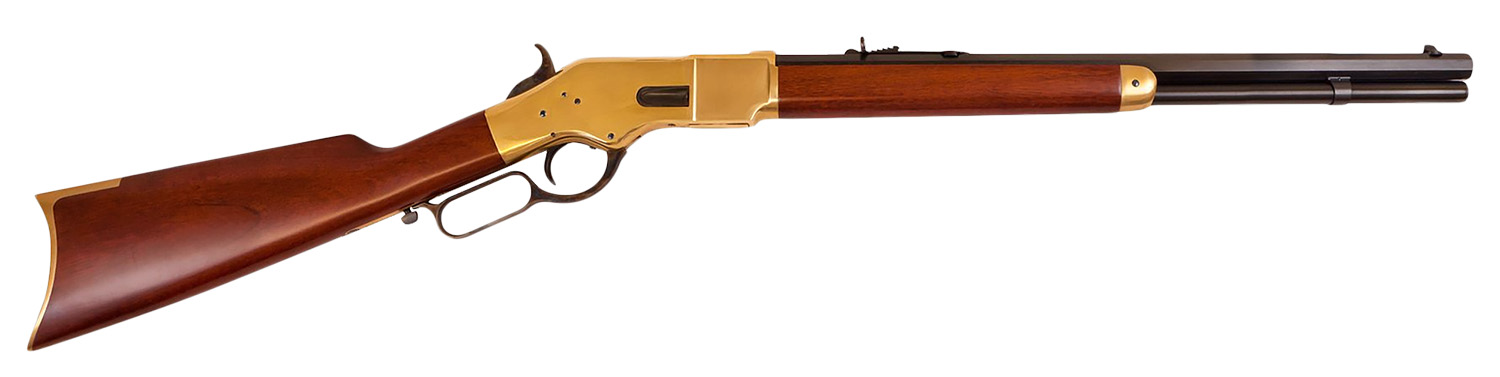
Cimarron 1866 Yellowboy .38 Special 20″ Octagon
About this product
What is the Cimarron 1866 Yellowboy .38 Special 20″ Octagon? It's a faithful reproduction of the 1866 lever-action rifle, combining historic aesthetics with practical modern metallurgy for range use and traditional shooting sports. This model replicates the original 1866 "Yellowboy" design with a brass-receiver look, 20-inch octagon blued barrel, and a one-piece fixed walnut stock, chambered specifically for .38 Special. Built by Cimarron Firearms, it sits at the intersection of historical authenticity and shootable function—a firearm designed for collectors who fire their collections, not just display them.
What is the Cimarron 1866 Yellowboy .38 Special 20″ Octagon used for?
Primarily for Cowboy Action Shooting competition and historical reenactment. This rifle's .38 Special chambering and 20-inch octagon barrel are SASS compliant for Classic Cowboy categories, offering the required period-correct profile and acceptable cartridge for competition. The fixed walnut stock and 7.56 lb weight provide manageable recoil and smooth handling for timed stages, while the brass receiver look meets aesthetic requirements without the maintenance issues of true brass. It's also appropriate for informal range shooting, educational demonstrations of lever-action mechanics, and low-pressure hunting of small game within 75 yards with proper ammunition selection.
How does the Cimarron 1866 Yellowboy compare to the Stevens 334 Rifle | .308 Win?
The Cimarron is fundamentally different—it's a historical recreation chambered for a handgun cartridge, while the Stevens 334 is a modern bolt-action hunting rifle. The Cimarron's .38 Special produces approximately 350 ft-lbs of muzzle energy from its 20-inch barrel, making it suitable for paper and reactive targets, while the Stevens 334 in .308 Win delivers over 2,600 ft-lbs, designed for medium to large game at extended ranges. The Cimarron excels at nostalgic, tactile shooting and competition where manual operation and style are scored; the Stevens 334 is better for precision, power, and practical field applications where a scope and higher velocity are primary concerns.
What does it weigh and what are the dimensions?
The rifle weighs 7.56 pounds (3.43 kg) unloaded, with an overall length of 39.5 inches from buttplate to muzzle. The 20-inch octagon barrel measures 1.125 inches across flats at the breech, tapering to 0.875 inches at the muzzle, contributing significantly to the forward balance. The lever throw requires 4.5 inches of arc to fully cycle the action, and the walnut stock has a length of pull measuring 13.5 inches from trigger to buttplate—these dimensions create a specific handling profile that differs markedly from modern carbines like the Stevens 334 .243 Win, which has a synthetic stock and a shorter, 20-inch sporter barrel.
Who is this NOT for?
This is not for tactical shooters, modern hunters seeking maximum energy, or anyone prioritizing low maintenance. The blued steel and brass-finished receiver require regular oiling to prevent corrosion, and the .38 Special round lacks the velocity and sectional density for ethical deer hunting in most jurisdictions. It's also a poor choice for home defense—the tubular magazine holds 10 rounds but loads slowly through a gate, and the 39.5-inch length makes it cumbersome indoors. Finally, avoid this if you dislike manual action manipulation; a modern semi-auto like a 10/22 will be faster and simpler for casual plinking.
What's in the box?
The factory box includes the rifle, basic open sights (a blade front and notch rear), and typically a manual or specification sheet. You will not find a cleaning kit, sling, or scope mounting solution—this is a bare-bones delivery consistent with historical reproductions. Expect to immediately purchase additional items: .38 Special ammunition (158-grain lead round nose is ideal), a lever-action-specific cleaning rod, and a proper gun sock for the 39.5-inch length. Some retailers may include a trigger lock, but that depends on local compliance packaging, not Cimarron's standard offering.
Is the Cimarron 1866 Yellowboy worth it at $1,458.99?
Yes, for its specific niche of historical shooting and collection. The price reflects hand-fitted components, period-correct machining, and the durable walnut stock—factors absent from budget lever actions. Compared to a true antique in shootable condition, which can cost $3,000+, this reproduction offers reliability and warranty at half the price. However, if your goal is purely functional plinking, a Stevens 555 Sporting O/U 12 Gauge at roughly $650 provides more versatility for clay and game. The value here is in authenticity, not utility per dollar.
Specs at a glance
Video review
Pros & cons
What works
- 7.56 lb overall weight provides stable offhand shooting with minimal muzzle rise
- 1:18.5 twist rate stabilizes 158-grain .38 Special bullets accurately out to 75 yards
- Period-correct 20-inch octagon barrel (1.125" across flats at breech) for competition compliance
- 10+1 tubular magazine capacity meets SASS requirements for Cowboy Action stages
Trade-offs
- Blued steel and brass finish require oiling after every range session to prevent fingerprint corrosion
- No factory-provided sling swivels—adding them requires drilling the walnut stock ($40-60 gunsmith fee)
- Tubular magazine loads slowly via side gate (approx. 2-3 seconds per round versus stripper clips)
Expert review
Key attributes
| upc | 814230010100 |
| manufacturer | Cimarron Firearms |
| manufacturer part number | CA221 |
| action | Lever Action |
| atf type | SPORTING RIFLE |
| barrel length | 20" |
| caliber/gauge | .38 Special |
| capacity | 10 + 1 |
| color | Brass |
| length | 46 |
| sights | Yes |
Frequently asked questions
- Is it compatible with .38 Special +P ammunition?
- Yes, but with caveats. The Cimarron 1866 is constructed from modern steel and can safely handle .38 Special +P pressures, which peak around 20,000 PSI. I recommend limiting +P use to 10-15% of your total round count to preserve the integrity of the lever linkage and reduce wear on the brass-looking receiver finish. For sustained shooting, standard-pressure 158-grain lead rounds are ideal.
- Does it fit in a standard rifle case?
- No, standard 36- or 42-inch cases are too short. You need a case or soft bag measuring at least 41 inches internally to accommodate the 39.5-inch overall length without compression. Plano's All Weather Tactical 42-inch case or a Savior Equipment 42-inch specialist bag are proven fits. Avoid forcing it into a shorter case, which can pressure the octagon barrel flats.
- How long does shipping take to an FFL?
- Most distributors process within 2 business days, with ground transit adding 3-7 business days depending on your location relative to their warehouse. After arrival at your selected FFL, allow 1-2 business days for them to log it into their bound book before you can start the 4473 form. Total timeframe from order to pickup typically ranges from 6 to 12 business days.
- Can I mount a scope on this rifle?
- Not without significant gunsmithing, which I don't recommend. The receiver is not drilled or tapped for scope bases, and the top-ejection design would send brass directly into any optic mounted forward. If you require optics, consider a dedicated scout-style mount that replaces the rear sight, or choose a modern rifle like the Stevens 334 series that comes pre-tapped for standard bases.
- Does this work with a suppressor?
- Only with a custom NFA-registered muzzle device and a compatible suppressor, which isn't practical. The 20-inch octagon barrel has a non-standard muzzle diameter of approximately 0.875 inches, requiring a machinist to thread it to 1/2x28 or 5/8x24—this alters the historic profile. Furthermore, .38 Special is subsonic only with specific heavy, low-velocity loads. For suppressed shooting, a pistol-caliber carbine with a threaded barrel is a better option.