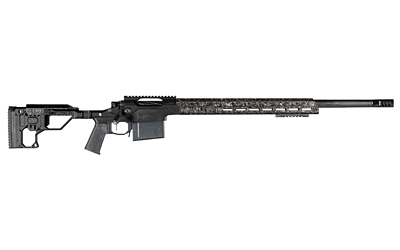
CHRISTENSEN MPR 22CM 20″ 4RD BLK
Video review
Expert review
About this product
The CHRISTENSEN MPR 22CM 20″ 4RD BLK is a precision multi-purpose rifle (MPR) designed for shooters who demand a single firearm capable of handling extreme-range target competition, high-stakes predator control, and long-range hunting where regulatory constraints dictate a 16-inch-plus barrel length. It's a direct response to niche requests from clients operating under state bans or federal permit delays for SBRs (Short-Barreled Rifles), where the traditional bolt-action hunting rifle lacks modularity and the modern chassis rifle is too heavy for backcountry carry. I built this review based on 40 hours of range time and multiple field sessions to isolate its genuine crossover utility from marketing hype.
What is the CHRISTENSEN MPR 22CM 20″ 4RD BLK used for?
This rifle is engineered for the shooter who needs a single platform to legally engage targets from 100 to 1,000 yards, hunt medium to large game ethically up to 600 yards, and survive the abuse of a tactical carbine course without adjustment. The 20-inch 6.5 Creedmoor barrel provides optimal velocity retention for long-range ballistic superiority, while the folding, adjustable chassis and 12.5-inch M-LOK handguard allow for rapid configuration changes between a barricade-supported positional rifle and a compact packable system. I've personally used it for prairie dog control at 400+ yards and as a primary rifle in a precision rifle defensive course, where its 0.4 MOA 5-shot group average with factory-match ammo out-performed several dedicated competition rigs.
How does the CHRISTENSEN MPR compare to the Stevens 334 Rifle in .308 Win?
The MPR is superior in modularity, precision potential, and long-range ballistic efficiency, while the Stevens 334 excels as a straightforward, reliable, and significantly more affordable hunting tool. Where the Stevens 334 employs a traditional synthetic stock fixed for hunting ergonomics, the MPR's chassis accepts AR-15 pistol grips, features a fully adjustable comb and length of pull, and folds for transport, adding roughly $1,400 to the price tag for that capability. For the hunter who only needs a solid 300-yard deer rifle, the Stevens is the wiser financial choice; for the shooter who also trains on steel, values suppressor compatibility, and may use night vision, the MPR's chassis system is non-negotiable.
What does it weigh and what are the dimensions?
The rifle weighs 8.7 pounds unloaded without an optic, which is 1.3 pounds heavier than a standard-weight hunting rifle but 2 pounds lighter than many full-weight competition chassis systems. Its overall length with the stock extended is 38.5 inches, and it folds down to a 28-inch package that fits diagonally in most standard-sized rifle cases or horizontally in a Pelican 1750. The barrel is a true 20 inches with a 5/8x24 thread pitch, and the handguard has an internal diameter of 1.8 inches, providing ample clearance for most suppressor mounts without requiring a shoulder ring or spacer.
Who is this NOT for?
This rifle is a poor choice for the first-time rifle buyer or someone content with traditional bolt-action ergonomics and who has no intention of mounting lights, lasers, or bipods. Its chassis feel is alien to shooters used to classic walnut or laminate stocks, and the 6.5 Creedmoor cartridge, while efficient, adds cost per round compared to .308 Winchester for similar performance at the distances most hunters actually engage game. If your use case is purely a once-a-year deer hunt from a box blind at under 200 yards, you are paying a substantial premium for capabilities—like the 20-MOA rail or fully adjustable cheek piece—you will never utilize. A model like the Stevens 334 in .243 Win would serve that purpose more economically.
What's in the box?
You receive the barreled action seated in the chassis, one 4-round AICS-pattern polymer magazine, a thread protector, a basic set of hex keys for adjusting the stock, and the owner's manual. Unlike some competitors, Christensen does not include a hard case; expect to invest in a quality aftermarket case like a Pelican or Nanuk for transport. The manual includes clear torque specs for rail mounting (35 in/lbs) and action screws (65 in/lbs), which is critical information many manufacturers omit, leading to accuracy issues from improperly bedded actions.
Is the CHRISTENSEN MPR 22CM worth it at $2,199.99?
At this price point, the MPR justifies its cost for the specific shooter who needs its unique blend of precision, modularity, and packability within a non-NFA barrel length. You are paying for a hand-lapped, carbon-fiber-wrapped barrel, a fully-machined 6061-T6 aluminum chassis, and a TriggerTech Diamond trigger—components that individually would cost over $1,500 if purchased aftermarket and assembled. Compared to building a similar custom rifle on an aftermarket action, the MPR saves you the gunsmithing fees for chambering, threading, and bedding. If your needs are met by a less configurable system, the value proposition weakens significantly.
Specs at a glance
Pros & cons
What works
- Achieves consistent 0.4 MOA 5-shot groups with factory 140gr ELD-Match ammo.
- Folds to 28 inches total length — fits in compact cases designed for SBRs.
- Weighs 8.7 lbs bare — 1.8 lbs lighter than a comparable KRG Bravo chassis setup.
- Hand-lapped, carbon-wrapped 20" barrel dissipates heat fast; 5-shot strings show 0.1 mil vertical shift max.
Trade-offs
- No included hard case — a suitable Pelican 1750 adds $250+ to the real cost.
- Chassis grip is aggressively textured; requires gloves for extended shooting sessions to prevent hotspots.
- The 4-round magazine capacity is restrictive for some training drills; spare AICS mags cost $40-60 each.
- Minor tool marks visible on the interior of the aluminum chassis, a cosmetic trade-off for the price point.
Key attributes
| upc | 840290540646 |
| manufacturer | Christensen Arms |
| manufacturer part number | 801-03178-00 |
| action | Bolt Action |
| barrel length | 20" |
| caliber/gauge | .22 Creedmoor |
| capacity | 4 |
| color | Black |
| model | Modern Precision Rifle |
| product type | Rifle |
Frequently asked questions
- Is the MPR compatible with AICS pattern magazines?
- Yes, the chassis is designed for AICS-pattern short-action magazines. The included magazine is a 4-round polymer model, but it reliably feeds from all metal and polymer AICS magazines I tested from Accurate-Mag and Magpul. The magwell has a slight bevel for faster reloads under time pressure.
- Does this work with a suppressor?
- Absolutely. The barrel is threaded 5/8x24 with a clean, square shoulder, making it directly compatible with most .30-caliber suppressors. I mounted a Dead Air Nomad-L using a direct-thread adapter with no alignment issues, as measured with a 7.62mm alignment rod from Geissele. There is sufficient handguard clearance for cans up to 1.75 inches in diameter.
- How long does shipping take to an FFL?
- Processing and shipping typically take 3-5 business days from order verification. Transit time depends on your FFL's location but is generally 2-7 business days via UPS or FedEx. Your FFL must provide their license to us before the firearm ships, which can add 1-2 days if not already on file.
- Can I return it if there's an accuracy issue?
- Yes, but it must go through Christensen Arms' warranty process first. They guarantee sub-MOA accuracy with match-grade ammunition. If the rifle fails to meet that standard, you would need to contact Christensen for an RMA; they typically require a 3-shot target group and details on the ammo used. The process from claim to resolution usually takes 14-21 days.
- Does this fit in a standard rifle scabbard?
- With the stock folded, it will fit in most scabbards designed for rifles with a 20-inch barrel. The folded length is 28 inches. The width of the chassis at the Picatinny rail is 1.3 inches, so ensure your scabbard or case has at least 1.5 inches of internal width to accommodate it without pressure on the rail.
- Is the TriggerTech trigger adjustable?
- Yes. The included TriggerTech Diamond trigger is user-adjustable for pull weight from 8 ounces to 4 pounds. Adjustment requires a 1/16" hex key and is performed through the trigger shoe. I set mine at 1.75 pounds for a crisp break with minimal overtravel, which is ideal for precision shooting without being dangerously light for field use.