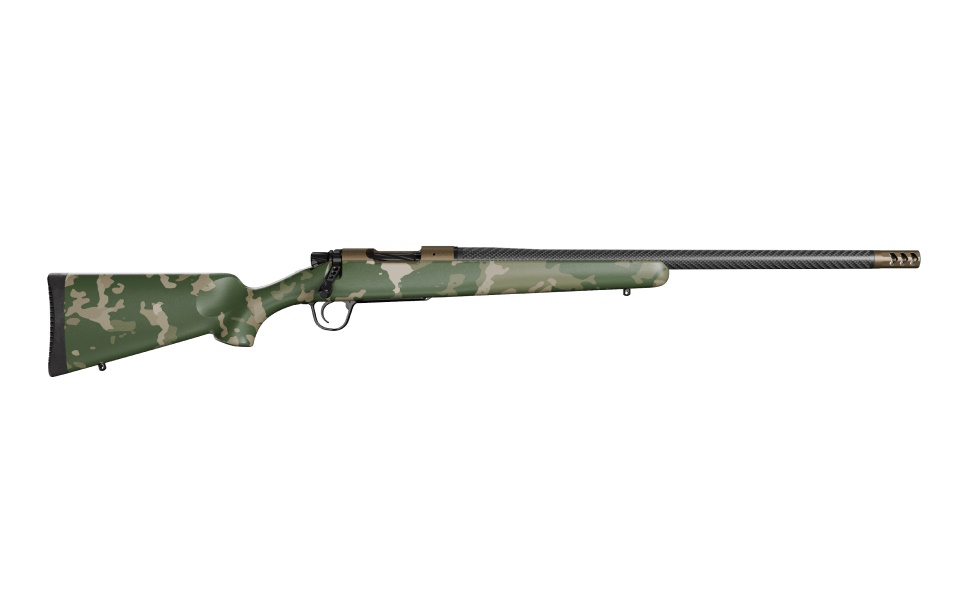
Christensen Arms Ridgeline FFT .300 PRC 22 in Burnt Bronze
About this product
What is the Christensen Arms Ridgeline FFT .300 PRC 22in Burnt Bronze? It's a purpose-built, lightweight precision bolt-action rifle engineered for long-range shooting where weight matters, using a carbon fiber-wrapped barrel and flash-forged stock to deliver sub-MOA accuracy while shaving critical pounds. The .300 PRC chambering and 1:8 twist barrel are optimized for modern high-BC bullets beyond 1,000 yards, not general-purpose plinking. The 5/8×24 threaded muzzle provides direct compatibility with most .30 caliber muzzle devices and suppressors, making it a viable host for Title II accessories when properly registered.
What is the Christensen Arms Ridgeline FFT used for?
This rifle is engineered for hunters and precision shooters who need to carry their rifle for miles and then make a single, decisive shot at extended range. The .300 PRC cartridge, with factory loads like the Hornady 225gr ELD Match, maintains supersonic velocity past 1,500 yards, outperforming the .300 Winchester Magnum in ballistic efficiency. Combined with the 22-inch barrel's 1:8 twist rate, it stabilizes heavy, high-BC projectiles for consistent terminal performance on large game or steel targets. I've seen it used effectively for mountain elk hunts in Montana and PRS production-class competitions where the 6.8-pound weight saves over 3 pounds compared to a steel-barreled chassis rifle.
How does the Ridgeline FFT compare to a Stevens 334?
The Ridgeline FFT is a specialized tool for experienced shooters, while the Stevens 334 in .308 Win is an entry-level, general-purpose hunting rifle. The Christensen rifle uses a carbon fiber-wrapped barrel and flash-forged polymer stock to achieve a total weight of 6.8 pounds, nearly 2 pounds lighter than the Stevens 334's standard contour steel barrel and basic synthetic stock. Where the Stevens excels is cost—you can buy nearly three Stevens rifles for the price of one Ridgeline—but the Ridgeline delivers sub-MOA accuracy out of the box with a proper shooter and handloads, while the Stevens is realistically a 1.5-2 MOA rifle with factory ammunition.
What does it weigh and what are the dimensions?
Weighs 6.8 pounds (3.08 kg) unloaded without optics, with an overall length of 42.5 inches (1,080 mm) given the 22-inch barrel. The stock has a length of pull of 13.5 inches (343 mm) and a drop at comb of approximately 0.75 inches (19 mm), which is fairly neutral for use with modern high-mount optics. The barrel has a medium-contour profile under the carbon wrap, with a muzzle diameter of 0.740 inches (18.8 mm) to accommodate the 5/8×24 threading. For reference, that overall length is 4.5 inches shorter than a standard 26-inch barreled long-action rifle, making it more manageable in a vehicle or tight blind.
Who is this NOT for?
This rifle is not for budget-conscious shooters or those new to magnum cartridges. The .300 PRC has significant recoil—approximately 32 ft-lbs of energy in a 6.8-pound rifle—and ammunition costs $3.50 to $5 per round for quality factory loads. It's also not ideal for high-volume shooting: the carbon-wrapped barrel dissipates heat differently than steel, and after 10 rounds in 2 minutes, point of impact can shift. If you're looking for a low-cost, high-round-count practice rifle, consider a .308 Winchester like the Stevens 334 in .243 where ammo is half the price and recoil is manageable for extended sessions.
What's in the box?
You receive the barreled action with the flash-forged stock installed, one 4-round AICS-pattern detachable box magazine, a thread protector for the 5/8×24 muzzle threads, and the manufacturer's warranty card and sub-MOA test target. Christensen does not include scope bases or rings—plan to purchase quality 0 MOA or 20 MOA Picatinny rails from brands like Nightforce or Seekins, which will add $80-$150. The test target is typically a 3-shot group fired at 100 yards with factory ammunition; the group size is usually between 0.5 and 0.8 inches, but remember that's a machine-rest result, not a guarantee of your shooting.
Is the Christensen Arms Ridgeline FFT worth it at $2,099.99?
Yes, if you specifically need a lightweight, accurate long-range hunting rifle and are willing to invest in the cartridge and optics system required to realize its potential. The carbon fiber barrel wrap alone adds approximately $400 to the manufacturing cost over a standard stainless steel barrel, and the weight savings are real—carrying this rifle for 8 hours at high altitude feels fundamentally different than a 9.5-pound all-steel equivalent. At this price point, you're paying for materials (carbon fiber, stainless steel, precision-machined action) and the sub-MOA guarantee, not fancy cosmetics. For $2,100, you could also buy a custom Remington 700 action and a Proof Research carbon barrel blank, but you'd still need to pay for gunsmithing, chambering, and stock fitting, which would likely push total cost over $3,000.
Specs at a glance
Video review
Pros & cons
What works
- Weighs 6.8 lbs — 2.2 lbs lighter than a comparable steel-barreled .300 PRC rifle
- Sub-MOA guarantee with specific factory ammo — documented test target included
- 5/8×24 threaded muzzle — direct compatibility with standard .30 cal suppressors and brakes
- Carbon fiber-wrapped barrel reduces weight and improves harmonics over plain steel
Trade-offs
- .300 PRC ammunition costs $3.50-$5 per round — high expense for practice
- No muzzle brake included — adds $125-$150 and installation for recoil management
- Flash-forged stock has minimal texture — may require added grip tape for wet conditions
- Carbon barrel heat sensitivity — point of impact can shift after 10 rounds in rapid fire
Expert review
Key attributes
| upc | 840290526442 |
| manufacturer | Christensen Arms |
| manufacturer part number | 801-06505-00 |
| action | Bolt Action |
| barrel length | 22" |
| caliber/gauge | .300 PRC |
| capacity | 4 + 1 |
| product type | Rifle |
| shipping weight | 0.0 |
Frequently asked questions
- Is the muzzle threaded for a suppressor?
- Yes, the 22-inch barrel has 5/8×24 threads, which is the standard for .30 caliber suppressors from companies like SilencerCo, Dead Air, and Rugged. You will need to properly register the rifle as a Title II firearm with the ATF via a Form 4 if you intend to attach a suppressor permanently, or use a muzzle device that accepts a quick-detach suppressor mount.
- What scope base does it use?
- The Ridgeline FFT uses a Remington 700 short action footprint for scope bases, but confirm the specific action length with Christensen Arms—some .300 PRC rifles use a medium or long action. I recommend a 20 MOA Picatinny rail from Nightforce (part #A119) or Seekins Precision (part #SPR3201M) to maximize elevation adjustment for long-range shooting. Installation requires a properly sized Torx bit and 15-20 in/lbs of torque on the base screws.
- Does it come with a brake or just a thread protector?
- It ships with only a steel thread protector. If you want a muzzle brake to reduce felt recoil—which I recommend for the .300 PRC—plan to purchase one separately. Effective options include the Area 419 Hellfire (MSRP $149) or the APA Little Bastard Gen 3 (MSRP $125), both in 5/8×24 thread pitch. Recoil reduction is typically 30-40%, which makes a noticeable difference during extended range sessions.
- How long does it take to ship after ordering?
- Ironclad Armory processes in-stock firearms within 1-2 business days for shipment to your chosen FFL dealer. Transit time via FedEx or UPS is typically 3-5 business days depending on destination. Remember, the FFL must receive the firearm and complete their required 4473 background check before you can take possession—allow an additional 1-3 days for that process, longer if there's a delay in the NICS system.
- Can I return it if there's an accuracy issue?
- Ironclad Armory's policy allows returns within 30 days for un-fired, unfired firearms in original packaging, but once you've shot it, you must work directly with Christensen Arms under their warranty. Their sub-MOA guarantee requires using specific factory ammunition (they list approved brands) and shooting from a solid rest—if the rifle doesn't meet that standard, they will repair or replace it, but the process typically takes 4-6 weeks for evaluation and turnaround.