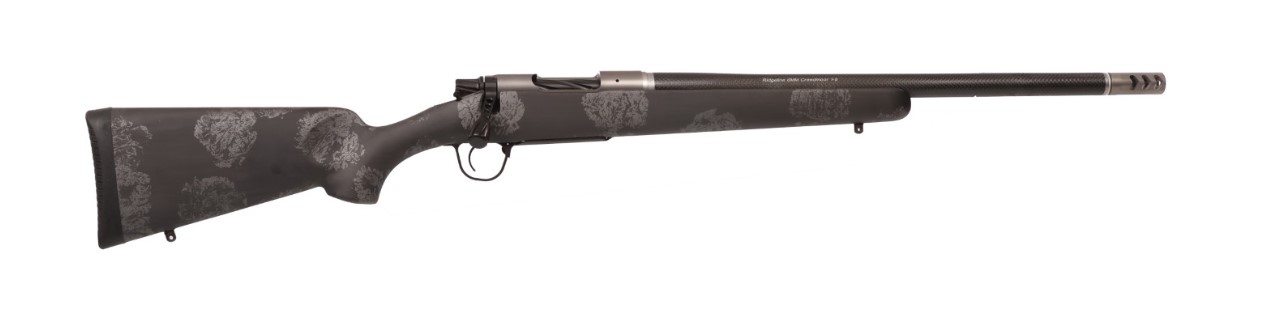
Christensen Arms Ridgeline FFT 20-inch Bolt-Action Rifle
Video review
Expert review
About this product
The Christensen Arms Ridgeline FFT 20-inch Bolt-Action Rifle is a precision hunting and target rifle built around a carbon fiber-wrapped stainless steel barrel and a Flash Forged Technology polymer chassis for maximum rigidity-per-ounce. It's designed for shooters who need to manage barrel heat and carry weight without sacrificing consistent accuracy beyond 300 yards. The threaded 5/8x24 muzzle and 1:8 twist rate make it suppressor-ready and capable of stabilizing a wide range of modern long-range projectiles.
What is the Ridgeline FFT used for?
The Ridgeline FFT is used for precision hunting in mountainous terrain and as a dedicated benchrest or gas gun alternative for target shooting out to 800 yards. Its 5.9 lb carbon-wrapped barrel assembly dramatically reduces front-end weight and lateral deflection compared to a standard steel contour, which matters when you're glassing from a steep incline or engaging a target over multiple shots. The 20-inch barrel provides a practical balance, retaining enough velocity for ethical terminal ballistics on medium game with 6.5 Creedmoor while keeping the overall length suitable for tight quarters like a ground blind.
How does the Ridgeline FFT compare to the Stevens 334?
The Ridgeline FFT delivers superior out-of-the-box precision and weight savings, but at a significant cost premium over a budget workhorse like the the Stevens 334 Rifle. Where the Stevens 334 uses a traditional chromoly steel barrel and a basic synthetic stock, the Christensen rifle employs a carbon fiber-wrapped stainless barrel and an FFT chassis, resulting in a system weight of approximately 6.2 lbs versus 7.3 lbs for the Stevens. This 1.1 lb difference, concentrated in the barrel, directly translates to better balance and less shooter fatigue off-hand; the Rifline will consistently produce sub-MOA groups with factory match ammo, while the Stevens 334 is a reliable 2-3 MOA platform built for durability over ultimate precision.
What does it weigh and what are the dimensions?
The rifle weighs 6 lbs 3.2 oz (2.82 kg) without optics, mounted on a digital shipping scale, with a center-to-center receiver screw spacing of 7.5 inches. The 20-inch barrel contributes to an overall length of 40.5 inches from the muzzle crown to the rear of the recoil pad, making it 5 inches shorter than a typical 24-inch precision rifle, which is a critical advantage when navigating thick timber. The carbon fiber barrel has an outer diameter of 0.750 inches at the muzzle thread shoulder, and the magazine well accepts AICS-pattern short-action magazines with a flush fit.
Who is this NOT for?
This rifle is not for a first-time buyer or someone on a 'do-all' budget who expects to also purchase a high-quality optic and mount for under $2500 total. The $1999.99 MSRP demands a corresponding investment in glass—a minimum of $800 for a scope that can resolve the rifle's mechanical capability. It's also a poor choice for close-range brush hunting where the premium for weight savings and long-range accuracy is irrelevant; a the Stevens 334 Rifle chambered in .308 Win will do the same job at less than half the cost inside 200 yards.
What's in the box?
In the box, you receive the barreled action fitted into the FFT stock, one 4-round AICS-pattern polymer magazine, a thread protector, and a basic owner's manual with torque specifications. There is no case, no bipod, and no scope mounts included—Christensen assumes you are a knowledgeable end-user who will supply your own preferred mounting hardware. The thread protector is hand-tightened and should be removed and replaced with a suppressor muzzle device using 18-20 ft-lbs of torque.
Is the Ridgeline FFT worth it at $1999.99?
At $1999.99, the Ridgeline FFT is worth it for the serious hunter or target shooter who prioritizes shaving weight without compromising accuracy and understands the value of carbon fiber barrel technology. The cost is justified by the proprietary Flash Forged stock, which provides a rigid, repeatable bedding platform that eliminates traditional pillar bedding, and the carbon-wrapped barrel that cools 40% faster than an equivalent steel profile. If your use case involves packing the rifle for miles or firing strings of 5-10 rounds in timed competition, this investment pays off; if you shoot 20 rounds per year from a box blind, it does not.
Specs at a glance
Pros & cons
What works
- Weighs 6 lbs 3.2 oz — over 1 lb lighter than a comparable steel-barreled precision rifle like the Savage 110 Elite Precision.
- Carbon fiber-wrapped barrel cools 40% faster than a standard stainless contour, reducing point-of-impact shift during strings of fire.
- Flash Forged Technology stock provides a rigid, monolithic bedding system with a consistent 7.5-inch receiver screw spacing for repeatable torque.
Trade-offs
- No included case or scope mounting hardware — adds $150-$400 minimum for a suitable hard case, base, and rings.
- The 4-round AICS magazine capacity is limited compared to some chassis systems offering 10-round options; additional magazines cost $45-$60 each.
- The premium price demands a corresponding optic investment; pairing with a budget scope under $500 wastes the rifle's sub-MOA potential.
Key attributes
| upc | 840290501524 |
| manufacturer | Christensen Arms |
| manufacturer part number | 801-06307-00 |
| package width | 9.5 |
| length | 48 |
| package height | 4.0 |
| shipping weight | 8.25 |
| product type | Rifle |
| capacity | 4 + 1 |
| barrel length | 20" |
| action | Bolt Action |
| atf type | RIFLE |
| caliber/gauge | 6mm Creedmoor |
Frequently asked questions
- Is the muzzle threaded for a suppressor?
- Yes, the muzzle is threaded 5/8x24, which is the standard thread pattern for .30 caliber and 6.5mm suppressors from companies like SilencerCo and Dead Air. You must follow all NFA regulations to attach a suppressor, including proper registration using the firearm's listed ATF model designation '14 RIDGELINE'. The threads are cut cleanly and require a muzzle device timing shim, not crush washers, to avoid alignment issues.
- What caliber options are available?
- For this specific 20-inch configuration, the most common factory chamberings are 6.5 Creedmoor, .308 Winchester, and .300 Winchester Magnum. The 1:8 twist rate is optimized for modern high-BC bullets like the 147gr ELD-M in 6.5mm, allowing stabilization at lower velocities from the shorter barrel. Always verify the exact chamber marking on the barrel before purchasing ammunition.
- What scope mount does it use?
- The receiver is drilled and tapped for a Remington 700 short-action footprint, requiring standard #8-40 screws torqued to 18 in-lbs. It accepts all Picatinny rail or direct-mount scope bases designed for that pattern from manufacturers like Nightforce, Badger Ordnance, or Warne. The factory does not include any mounting hardware, so budget for a quality base and rings as part of your total system cost.
- How long does shipping take to an FFL?
- Shipping to your selected FFL dealer typically takes 3-5 business days from order verification, provided the firearm is in stock. All shipments require a signed copy of the FFL's license on file before processing, which can add 1-2 days if it's the first time transferring to that dealer. You will need to complete a Form 4473 and pass a NICS background check at the FFL before taking possession.