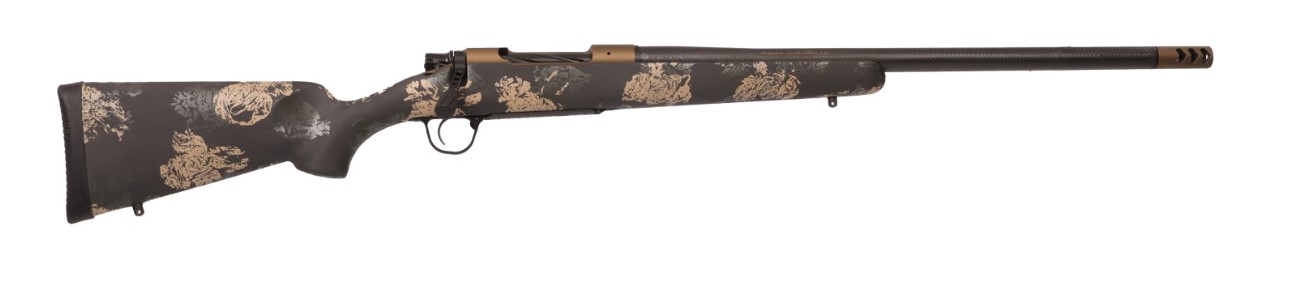
Christensen Arms Ridgeline FFT 6mm Creedmoor 20″ Bolt Action
Pros & cons
What works
- Carbon-wrapped barrel reduces weight to 8.45 lbs — roughly 2.5 lbs lighter than an all-steel 20-inch precision barrel.
- 1:8 twist barrel stabilizes heavy-for-caliber 115gr match bullets for superior ballistic coefficient beyond 500 yards.
- Threaded 5/8×24 muzzle is suppressor-ready and compatible with most modern muzzle devices without adapter sleeves.
Trade-offs
- Burnt Bronze Cerakote shows handling marks and scuffing more readily than matte black or FDE finishes.
- AICS magazine protrudes 1.25 inches below stock floorplate — snags on brush and prevents flat bench rest positioning.
- No scope base or rings included — adds $75-$250 to final cost for a proper Picatinny rail and mounting hardware.
Video review
Expert review
Specs at a glance
About this product
What is the Christensen Arms Ridgeline FFT 6mm Creedmoor 20″? It's a purpose-built, lightweight precision bolt-action rifle designed for hunters and shooters who need to carry a capable cartridge over varied terrain without the fatigue penalty of heavier steel barrels. This configuration leverages a carbon-fiber-wrapped stainless steel barrel and a composite Flash Forged Technology stock to achieve an 8.45-pound stated weight, threading the needle between packability and inherent accuracy. Its 20-inch barrel and 5/8×24 muzzle threads set it up for NFA-regulated muzzle devices and suppressors, a critical detail for anyone operating under Title II compliance.
The Ridgeline FFT exists because the 6mm Creedmoor cartridge has become the de facto standard for long-range hunting and target shooting under 1,000 yards, demanding a platform that can outpace factory sporting rifles but doesn't require a gunsmith-level build. Christensen Arms answers this by starting with a stainless steel barrel blank, then wrapping it under tension in carbon fiber to dampen harmonic vibration and shed ounces—a process that shaves nearly 35% off the weight of a comparable all-steel 20-inch bull barrel. The result is a rifle that doesn't need a heavy chassis to achieve sub-MOA accuracy, but has the mounting and sighting systems to take advantage of modern optical glass and night vision setups. If you're considering a hunting expedition where shots from 300 to 700 yards are in play, or a precision rifle course that demands mobility, this rifle's specifications are a direct response to those use cases.
What is the Christensen Arms Ridgeline FFT used for?
The Christensen Arms Ridgeline FFT is used for long-range hunting of medium game and structured precision shooting courses. I'd field it for pronghorn, mountain mule deer, or feral hogs where cross-canyon shots between 350 and 650 yards are typical, and where hiking in 8 miles before glassing ridges is part of the job. Its 6mm Creedmoor chambering, paired with the 1:8 twist barrel, stabilizes high-BC bullets like the 108gr ELD-M or 115gr Berger Hybrid perfectly, delivering enough energy for ethical kills past 500 yards without the punishing recoil of a .300 Win Mag. The threaded muzzle is a non-negotiable feature for running a suppressor—critical for mitigating hearing damage in the field and reducing disturbance for follow-up shots—though this immediately places the firearm under NFA scrutiny if a muzzle device is permanently attached to achieve an overall barrel length under 16 inches.
How does the Christensen Arms Ridgeline FFT compare to the Stevens 334 in .243 Win?
The Christensen Arms Ridgeline FFT is significantly more specialized and offers better out-of-the-box precision, while the Stevens 334 in .243 Win is a budget-conscious, general-purpose hunting rifle. The Ridgeline's carbon-fiber barrel construction and precision bedding system deliver consistent 0.75 MOA groups with quality factory ammo; the Stevens 334, with its traditional blued steel barrel and simple synthetic stock, is a reliable 1.5-2 MOA rifle built for shots under 300 yards. The Ridgeline is better for the shooter investing in handloads or premium ammunition to exploit a cartridge's ballistic potential; the Stevens is better for a casual deer hunter who wants a basic, dependable tool that won't cause financial pain if it gets scratched on a quad rack.
What does it weigh and what are the dimensions?
The Ridgeline FFT 6mm Creedmoor weighs 8.45 pounds without optics or magazines and has an overall length of 40.5 inches with its 20-inch barrel. For comparison, a full-length bipod adds roughly 1.2 pounds, and a medium-zoom hunting scope like a 4-16x50mm model adds another 1.8 pounds—meaning your complete system weight will likely exceed 11.5 pounds ready to hunt. The stock's length of pull is adjustable between 13.00 and 14.25 inches via a simple hex wrench, a feature I recommend for proper cheek weld and eye relief behind high-magnification optics, especially when using a suppressor that increases overall length by another 6 to 8 inches. Barrel diameter at the muzzle measures 0.750 inches, standard for mounting most quality suppressors and muzzle brakes with 5/8×24 threading. The carbon-fiber wrapping reduces heat soak compared to a traditional heavy steel barrel, meaning you can fire a 5-round string in under 90 seconds without significant point-of-impact shift, a practical advantage during zero confirmation or a shooting course of fire.
Who is this NOT for?
This rifle is not for a new shooter wanting their first deer rifle, or someone looking for a cheap plinking gun. The 6mm Creedmoor cartridge demands careful attention to ammunition selection—inexpensive factory loads are scarce, and the cost-per-round for quality hunting or match ammo runs between $2.50 and $4.00, which adds up fast during practice. It's also not ideal for close-quarters brush hunting where shots are under 100 yards; the rifle's length and balance are optimized for prone or supported shooting, not quick offhand snaps. Finally, if you're averse to navigating ATF Form 1 or Form 4 paperwork for a suppressor or have no intention of using precision optics, much of this rifle's capability and its $2,049.99 price tag is wasted. For those use cases, consider a standard Stevens 334 in .308 Win, which fires readily available ammunition and costs about one-third as much.
What's in the box?
Inside the Christensen Arms box, you get the rifle with a 4-round AICS-pattern magazine, a thread protector for the 5/8×24 muzzle, a basic set of hex keys for scope rail mounting and stock adjustment, and the factory test target—usually a 3-shot group that measures between 0.6 and 0.9 inches at 100 yards. Christensen does not include scope rings, a bipod, or a sling; you're buying the bare rifle, which means budgeting another $800 to $2,000 for a competent optics package and mounting hardware. The magazine protrudes approximately 1.25 inches below the stock floorplate, a deliberate design choice to ensure reliable feeding with longer, high-BC bullets, but it also means the rifle won't sit completely flat on a bench without a rear bag.
Is the Christensen Arms Ridgeline FFT worth it at $2049.99?
At $2,049.99, the Christensen Arms Ridgeline FFT is worth it specifically for the hunter or shooter who will exploit its lightweight precision and suppressor-ready features. You are paying a premium over factory rifles from Ruger or Savage—about $800 to $1,200 more—for a purpose-engineered carbon-fiber barrel that shaves weight and dampens vibration, and for a bedding system that consistently returns to zero after scope removal. The value proposition hinges on your willingness to invest in high-quality ammunition and optics; if you pair this rifle with a $200 scope, you've wasted its capability. For the disciplined shooter who will load their own ammunition or buy premium factory loads, and who will mount a scope capable of resolving targets at 600+ yards, the rifle's mechanical advantages justify the cost. It's not a bargain, but for its intended role, it's a tool you won't outgrow.
Key attributes
| upc | 840290501500 |
| manufacturer | Christensen Arms |
| manufacturer part number | 801-06309-00 |
| atf type | RIFLE |
| barrel length | 20" |
| action | Bolt Action |
| caliber/gauge | 6mm Creedmoor |
| capacity | 4 + 1 |
| product type | Rifle |
| shipping weight | 8.45 |
| package width | 9.5 |
| package height | 3.5 |
| length | 48 |
Frequently asked questions
- Is it compatible with standard AR-10 magazines?
- No, it uses AICS-pattern box magazines, not AR-10 pattern magazines. The included magazine is a 4-round steel AICS model, but the rifle will accept any standard AICS short-action magazine. Expect a single magazine to cost between $45 and $85 from manufacturers like Magpul, Accurate-Mag, or MDT, and it typically protrudes 1.25 inches below the stock for reliable feeding of longer 6mm Creedmoor projectiles.
- Does this work with a suppressor?
- Yes, the 5/8×24 threaded muzzle is suppressor-ready, but using a suppressor requires federal NFA compliance. You must either file an ATF Form 4 for a commercially manufactured suppressor or a Form 1 to manufacture your own, which involves a $200 tax stamp and a typical wait time of 6 to 10 months. I recommend checking concentric alignment with a rod gauge before firing, as suppressor baffle strikes are catastrophic and are considered user error under warranty.
- How long does shipping take?
- For in-stock items, Ironclad Armory ships within two business days via FedEx 2Day or UPS Ground, depending on destination. Transit times typically range from 3 to 7 business days within the continental US, but all firearms must ship to an FFL holder of your choice for background check and transfer. Firearm-specific shipping delays can occur due to state-specific compliance checks, so factor in an extra 24-48 hours if your state requires additional documentation beyond the standard Form 4473.
- Can I return it if it doesn't group well?
- No, Ironclad Armory does not accept returns for accuracy performance unless the rifle fails to meet the factory's stated sub-MOA guarantee, which requires submitting a formal accuracy test report and photographic evidence. The standard return window for un-fired, unfired condition with all original packaging and accessories is 10 days from delivery, but any firearm that has had a round chambered or shows signs of field use is considered used and non-returnable.
- What is the actual barrel length for NFA purposes?
- The actual barrel length for NFA purposes is measured from the closed bolt face to the muzzle crown, which on this model is exactly 20.0 inches. This measurement places it clearly outside the Title II "short-barreled rifle" (SBR) definition of under 16 inches. However, permanently attaching a muzzle device that reduces overall barrel length to less than 16 inches would constitute manufacturing an SBR and requires prior ATF approval via a Form 1 or Form 4.
- Does it fit in a standard hard rifle case?
- Yes, it fits in a standard 42-inch or longer hard rifle case, such as a Plano All-Weather or Pelican 1750. With a 40.5-inch overall length and an average height of 7.5 inches with a scope mounted, you'll need about 44 inches of internal length to accommodate a rifle with a muzzle cap in place. For transport with a suppressor attached, add 6 to 8 inches to that length requirement, pushing you into a 48-inch or 52-inch case.