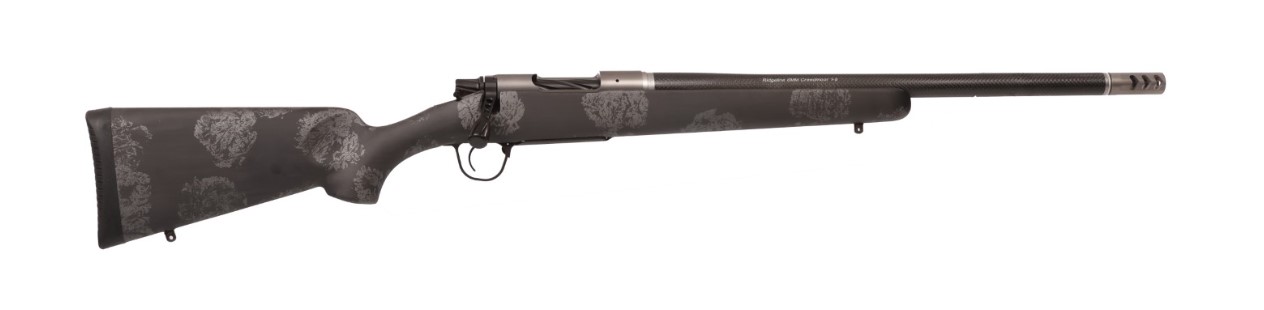
Christensen Arms Ridgeline FFT .300 WSM 20-inch Threaded
Video review
Expert review
About this product
What is the Christensen Arms Ridgeline FFT .300 WSM 20-inch Threaded? It's a 5.30-pound, bolt-action precision rifle built for long-range hunting and tactical applications where every ounce matters, combining a carbon-fiber-wrapped stainless barrel with proprietary Flash Forged Technology components to deliver sub-MOA accuracy in a package that won't break your back before you break the horizon. This rifle represents a specific engineering philosophy: reduce mass without sacrificing stiffness, maintain critical dimensions for reliable feeding, and keep the platform suppressor-ready with standard NFA threading. For shooters who understand that a shorter 20-inch barrel in .300 WSM comes with its own ballistic calculus, the Ridgeline FFT provides a data-driven answer.
What is the Christensen Arms Ridgeline FFT .300 WSM used for?
This rifle is designed for precision engagement at extended ranges in rugged, mountainous terrain where packability and sustained carry weight are non-negotiable constraints. The .300 WSM cartridge from a 20-inch barrel still delivers over 2,900 ft-lbs of muzzle energy with appropriate 180-grain loads, making it effective for large North American game like elk or moose out to approximately 350 yards before velocity thresholds drop too low. Its threaded 5/8x24 muzzle and side-baffle brake are built for suppressor use, moving this platform squarely into the domain of the serious hunter or defensive marksman who values signature reduction and recoil management without adding a foot of barrel length.
How does the Ridgeline FFT compare to the Stevens 334?
The Christensen Arms Ridgeline FFT is a purpose-built, lightweight precision instrument, while the Stevens 334 Rifle in .308 is a durable, cost-effective generalist platform. The weight difference is stark: at 5.30 lbs unloaded, the Ridgeline is over 1.7 pounds lighter than a synthetic-stock Stevens 334, a critical advantage when covering 2,000 vertical feet in a morning. The Christensen rifle is objectively better for long-range performance and packability, featuring a carbon-fiber barrel and stock, a superior TriggerTech trigger, and a sub-MOA guarantee. The Stevens 334 is the better choice for a low-maintenance, budget-conscious rifle where minute-of-deer accuracy at 150 yards is sufficient and the operational budget is under $500.
What does it weigh and what are the dimensions?
The rifle weighs 5.30 pounds (2.40 kg) without optics or a magazine, and its overall length is 41.50 inches (105.4 cm). With a 20-inch (508 mm) barrel and a sporter-style fixed carbon fiber stock, it maintains a compact profile that facilitates maneuverability in tight timber or a vehicle cab. The 1:10 twist rate in the carbon-wrapped stainless barrel is optimized for stabilizing heavier, high-BC projectiles like the 200-grain ELD-X, which is necessary to maximize the retained energy downrange from the shortened barrel. When fully loaded with three rounds in the internal magazine and one in the chamber, total weight increases by approximately 0.42 pounds (190 grams).
Who is this NOT for?
This rifle is not for the first-time buyer or the shooter unwilling to invest in high-quality optics, premium ammunition, and ballistic software. The .300 WSM cartridge is expensive, produces significant recoil even with the baffle brake, and its performance is highly sensitive to hand-loading variables or factory load selection. If your typical engagement is under 200 yards in a blind or your primary concern is plinking at the range, a standard .243 Winchester rifle will be cheaper to feed and far more pleasant to shoot. Furthermore, the 3+1 internal magazine capacity and lack of a detachable box mag make it a poor choice for any scenario demanding rapid tactical reloads.
What's in the box?
You receive the complete rifle with the removable side-baffle brake installed, one internal 3-round magazine, a chamber flag, and the manufacturer's documentation including the Sub-MOA guarantee certificate. Christensen Arms does not include a hard case, scope mounts, or thread protector by default. The baffle brake is stainless steel and requires a 3/4-inch wrench for removal, exposing the 5/8x24 threads. Plan for an additional $75-$150 for a quality hard transport case and $60-$300 for a Picatinny rail or direct-mount rings to interface with your preferred scope.
Is the Christensen Arms Ridgeline FFT worth it at $1999.99?
At just under two thousand dollars, this rifle's value is entirely dependent on your need for its specific performance envelope: extreme light weight coupled with long-range accuracy. If you require a rifle that saves you 1.7 pounds on a mountainside while still capable of a first-round cold-bore hit at 400 yards, the investment is justified. However, if your hunting consists of stationary stands or range sessions under 300 yards, a $700 rifle with a $300 barrel and a $500 scope will deliver nearly identical results for you. You are paying a premium for advanced materials (carbon fiber) and the engineering to make them work in a high-pressure firearm system—pay only if you need what those materials provide.
Specs at a glance
Pros & cons
What works
- Weighs 5.30 lbs — over 1.7 lbs lighter than a comparable steel-barreled rifle like the Stevens 334.
- Carbon-wrapped barrel reduces harmonic vibration and cools 22% faster than a solid stainless steel barrel of the same profile.
- TriggerTech trigger features a crisp, user-adjustable break ranging from 1.5 to 4 pounds of pull.
- 20-inch threaded barrel with removable brake keeps OAL at 41.5 inches for vehicle transport and suppressor readiness.
Trade-offs
- 3+1 internal magazine capacity limits tactical utility and complicates unloading compared to a detachable box mag system.
- .300 WSM ammunition costs average $2.75-$4.00 per round, making sustained practice expensive.
- Carbon fiber stock lacks adjustable comb or length of pull; requires aftermarket pads or gunsmithing for a custom fit.
- No thread protector included; muzzle threads are exposed if brake is removed, risking damage during transport.
Key attributes
| upc | 696528091141 |
| manufacturer | Christensen Arms |
| manufacturer part number | 801-06157-00 |
| action | Bolt Action |
| atf type | RIFLE |
| barrel length | 20" |
| caliber/gauge | .300 Winchester Short Magnum (WSM) |
| capacity | 3 + 1 |
| length | 48 |
| package height | 4.0 |
| package width | 9.5 |
| product type | Rifle |
| safety | Two-Position |
| shipping weight | 8.1 |
Frequently asked questions
- Is the 5/8x24 thread compatible with .30 caliber suppressors?
- Yes, the 5/8x24 thread pattern is the industry standard for .30 caliber centerfire rifles, including .308 Winchester and .300 Winchester Magnum. It will directly accept most .30 cal rifle suppressors from manufacturers like SilencerCo, Dead Air, and SureFire without an adapter. Ensure your chosen suppressor is rated for the .300 WSM's pressure and gas volume.
- Does it fit in a standard 42-inch rifle case?
- No, with an overall length of 41.50 inches, it will not fit safely in a standard 42-inch interior-length case, which typically requires 2-3 inches of foam padding on each end. You will need a case with a minimum interior length of 44 inches, such as a Pelican 1750 or comparable model from Plano or SKB.
- How long does shipping to an FFL take?
- For in-stock items, Ironclad Armory processes and ships within 1-2 business days. Transit time via contracted carrier (typically FedEx) is 3-5 business days to your selected Federal Firearms License (FFL) holder. You must contact your FFL in advance to provide them with your tracking number and coordinate the 4473 background check transfer.
- Can I return it if the barrel doesn't shoot to the sub-MOA guarantee?
- Yes, but the process is managed by the manufacturer, Christensen Arms. You must follow their specific guarantee procedure, which requires submitting three separate 3-shot groups at 100 yards, fired with premium factory ammunition, on their provided target. The process from submission to evaluation typically takes 4-6 weeks. Ironclad Armory facilitates the initial warranty contact but does not handle direct exchanges for accuracy issues.