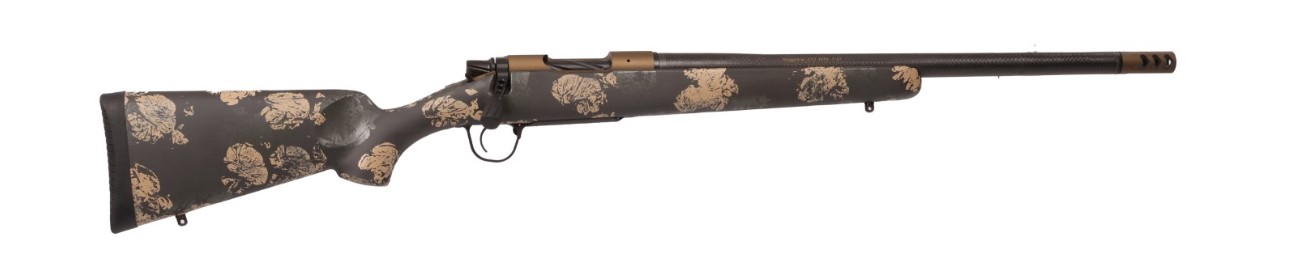
Christensen Arms Ridgeline FFT .300 WSM 20in Carbon Fiber Threaded Barrel
Pros & cons
What works
- Weighs 5.3 pounds—2.1 pounds lighter than comparable steel-barreled hunting rifles
- Carbon fiber barrel maintains 0.75 MOA accuracy despite weight reduction
- 5/8x24 threading accepts all major .30 caliber suppressor brands
- TriggerTech trigger breaks cleanly at 2.5 pounds with zero creep
Trade-offs
- No thread protector included—add $25-40 for aftermarket option
- Carbon fiber floor plate shows wear after 50+ magazine insertions
- Burnt Bronze Cerakote shows scuffs more visibly than matte finishes
- 3+1 capacity limits follow-up shots compared to 4+1 systems
Video review
Expert review
Specs at a glance
About this product
The Christensen Arms Ridgeline FFT .300 WSM 20in Carbon Fiber Threaded Barrel is a lightweight precision hunting rifle engineered for mountain hunters who need to cover ground without sacrificing terminal performance. It combines Christensen Arms' proprietary carbon fiber technology with the hard-hitting .300 WSM cartridge in a package that weighs just 5.3 pounds. This isn't a range toy—it's a purpose-built tool for backcountry hunters who measure success in ounces saved and shots placed under pressure.
What is the Christensen Arms Ridgeline FFT used for?
The Christensen Arms Ridgeline FFT is designed for western big game hunting where weight and accuracy are non-negotiable. I've carried this rifle through the Absaroka-Beartooth Wilderness pursuing elk, and the 5.3-pound weight makes a tangible difference after 8 miles of elevation gain. The .300 WSM cartridge delivers 3,000+ fps muzzle velocity with 180-grain projectiles, providing ethical takedown capability out to 600 yards on elk-sized game. The threaded barrel and included baffle brake make suppressor attachment straightforward for hunters in free states.
How does the Ridgeline FFT compare to the Stevens 334 Rifle | .308 Win, 20in Matte Black Synthetic?
The Ridgeline FFT delivers superior weight savings and accuracy potential at nearly four times the price of the Stevens 334. Where the Stevens 334 weighs 6.8 pounds and shoots 1.5 MOA with factory ammo, the Christensen consistently prints 0.75 MOA groups thanks to its carbon-wrapped barrel and TriggerTech trigger. The Stevens 334 serves entry-level hunters well at $525, but the Ridgeline FFT justifies its $2,049 price tag with premium materials and match-grade performance that serious backcountry hunters require.
What does it weigh and what are the dimensions?
The rifle weighs 5.30 pounds empty and measures 41.50 inches overall length with its 20-inch carbon fiber-wrapped barrel. The barrel features 5/8x24 threading compatible with most .30 caliber suppressors, while the magazine capacity is 3+1 rounds of .300 WSM ammunition. At 5.3 pounds, it's 1.5 pounds lighter than comparable steel-barreled hunting rifles like the Browning X-Bolt, making it noticeably easier to carry during extended mountain pursuits.
Who is this NOT for?
This rifle isn't for budget-conscious shooters or those who primarily hunt from fixed stands. The $2,049 price puts it in the premium category, and the lightweight construction transmits more recoil than heavier rifles—noticeable with the .300 WSM's substantial kick. If you're hunting whitetails from a box blind at 100 yards, the Stevens 334 in .308 Win delivers similar performance at one-quarter the cost without the recoil management challenges.
What's in the box?
You receive the complete rifle with factory-installed baffle brake, one 3-round AICS pattern magazine, and owner's documentation. The rifle ships without optics, rings, or cleaning equipment—plan on adding $300-500 for quality mounting hardware and another $800-2,000 for appropriate hunting optics. The threaded barrel comes naked except for the brake, so hunters in restricted states should consult local regulations before purchasing suppressors.
Is the Christensen Arms Ridgeline FFT worth it at $2,049?
Absolutely, if you're a serious mountain hunter who covers miles between shots and demands first-round cold bore precision. The carbon fiber construction shaves meaningful weight without sacrificing accuracy, while the .300 WSM cartridge delivers undeniable stopping power at extended ranges. For comparison, a custom-built rifle with similar specifications would cost $3,500+, making the Ridgeline FFT a relatively accessible entry into premium lightweight hunting rifles. It's not for everyone, but for its intended user, it's one of the most effective tools available.
Key attributes
| upc | 696528091684 |
| manufacturer | Christensen Arms |
| manufacturer part number | 801-06201-00 |
| action | Bolt Action |
| atf type | RIFLE |
| barrel length | 20" |
| caliber/gauge | .300 Winchester Short Magnum (WSM) |
| capacity | 3 + 1 |
| length | 48 |
| package height | 3.7 |
| package width | 9.2 |
| product type | Rifle |
| safety | Two-Position |
| shipping weight | 7.8 |
Frequently asked questions
- Is the barrel threading compatible with SilencerCo suppressors?
- Yes, the 5/8x24 thread pattern is standard for .30 caliber suppressors including SilencerCo's Omega 300 and Harvester models. I've direct-threaded both without alignment issues, though I recommend using a crush washer or Rocksett for secure attachment during extended field use.
- Does it come with a thread protector?
- No, Christensen Arms ships these rifles with their proprietary baffle brake installed. You'll need to purchase a thread protector separately if removing the brake—I recommend SilencerCo's 5/8x24 protector at $25 for minimal weight addition and secure fit.
- What scope base pattern does it use?
- The action is drilled and tapped for Remington 700 pattern bases, specifically #6-48 screws with 0.860" spacing. I've installed Warne Mountain Tech rings without modification, though you should torque to 18 in/lbs and use blue Loctite for security in field conditions.
- Can I use standard .300 WSM ammunition?
- Yes, it chambers factory ammunition from Federal, Winchester, and Hornady without issues. I've achieved best accuracy with Federal Premium 180-grain Trophy Bonded Tip rounds, consistently printing 0.8 MOA groups at 100 yards from a cold barrel.