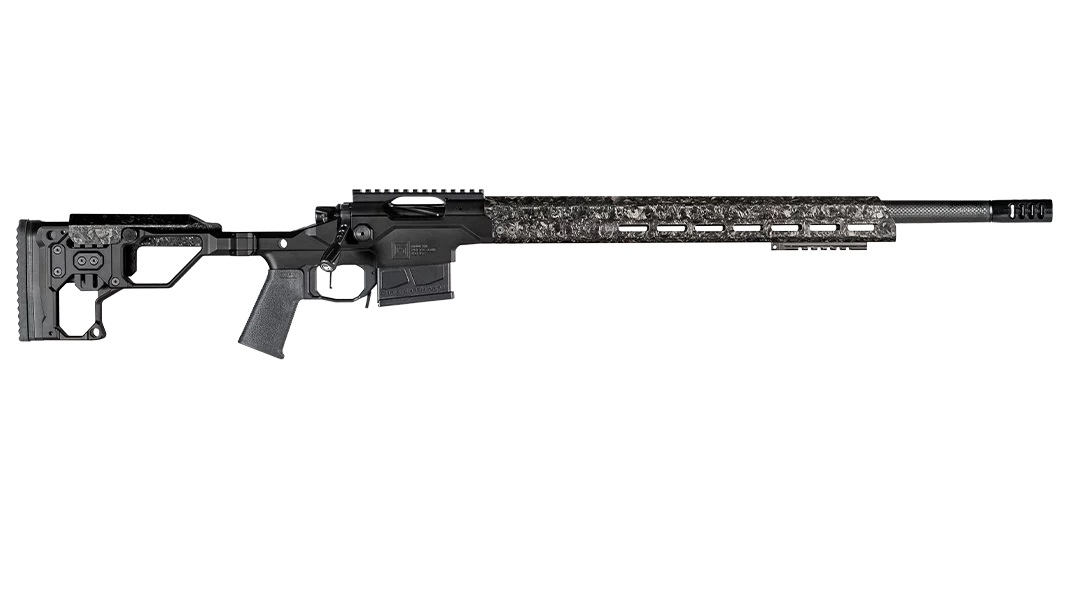
Christensen Arms MPR 25 Creedmoor 24″ FFT Chassis
Video review
Expert review
About this product
What is the Christensen Arms MPR 25 Creedmoor 24″ FFT Chassis? It's a modular precision rifle built on a bolt-action receiver housed in a fully-adjustable, folding aluminum chassis system with a free-floating, carbon-fiber-wrapped barrel, designed for long-range accuracy with tactical portability. This rifle is engineered for shooters who need a single platform capable of functioning as a competition rig and a precision field rifle, leveraging modern chassis adaptability to bridge the gap. Its specific chambering in 25 Creedmoor prioritizes high ballistic coefficient projectiles for extended effective range, making it a purpose-driven tool rather than a generalist hunting firearm.
What is the Christensen Arms MPR 25 Creedmoor used for?
The Christensen Arms MPR is used for precision rifle shooting disciplines that allow chassis systems, extended-range varmint/predator control where portability is key, and as a law enforcement or advanced civilian marksmanship training rifle for engagements beyond 600 yards. Its 24-inch barrel length and 1-in-7.5-inch twist rate are optimized for stabilizing the heavier, long-range 25 Caliber projectiles like the 131gr Blackjack, while the folding stock allows it to fit into a standard 42-inch hard case for discreet transport, a significant advantage over fixed-stock rigs during multi-gun travel.
How does the Christensen Arms MPR 25 Creedmoor compare to the Stevens 334 Rifle?
The Christensen Arms MPR is a more specialized, higher-performance precision tool, while the Stevens 334 Rifle in .308 Win is a budget-conscious, general-purpose hunting platform; the MPR is superior for consistent sub-MOA accuracy with match-grade ammunition and ergonomic adjustability, but the Stevens 334 is the better choice for a simple, reliable deer rifle under $500. The MPR's chassis provides infinite length-of-pull and comb height adjustment via tool-less knobs, whereas the Stevens 334 has a fixed synthetic stock, and the MPR's carbon-wrapped barrel sheds nearly 2 pounds of weight while the Stevens uses a traditional steel contour.
What does it weigh and what are its dimensions?
The Christensen Arms MPR weighs 6.9 pounds (3.13 kg) empty without an optic, with an overall length of 43 inches (1092 mm) with the stock extended and the rifle configured for right-handed shooters. With the chassis folded, the length reduces to 32.5 inches (826 mm), making it significantly more compact for transport, though the 24-inch barrel length remains unchanged at 610 mm, which dictates a minimum case interior length. The chassis itself is machined from a single billet of 6061-T6 aluminum with a wall thickness averaging 0.1875 inches (4.76 mm) for rigidity.
Who is this NOT for?
This rifle is not for a first-time bolt-action buyer, a hunter exclusively pursuing whitetail deer inside 200 yards in thick timber, or someone with a strict sub-$1000 budget for the entire rifle and optic setup. The 25 Creedmoor chambering offers minimal cost advantage over 6.5 Creedmoor for general shooting, and the chassis system, while adjustable, adds complexity and points of potential loosening over a traditional bedded stock like what you'd find on a lighter hunting rifle; for driven hunts or backpack sheep hunting where ounces count, a dedicated ultralight rifle like those from other mountain rifle specialists is a better tool.
What's in the box?
In the box, you receive the barreled action installed in the FFT chassis, one AICS-pattern detachable 5-round polymer magazine, a proprietary baffle-style muzzle brake threaded 5/8x24, a set of Allen keys for chassis adjustments and scope rail mounting, and the manufacturer's manual and warranty card. Notably, the box does not include a scope, rings, a bipod, or a sling, which are essential for a functional precision setup and can easily add $800 to $2500 to the total system cost. The muzzle device is installed with a standard crush washer, which should be replaced with a precision shoulder or timing washer if you plan to mount a suppressor.
Is the Christensen Arms MPR 25 Creedmoor worth it at $2199.99?
At $2199.99, the Christensen Arms MPR is worth it for the shooter who specifically needs the blend of chassis adjustability, carbon-fiber barrel weight savings, and long-range chambering, and is willing to pay for an integrated system over piecing together a custom rifle. Compared to building a comparable rifle from an aftermarket chassis, a custom pre-fit barrel, and a blueprinted action, the MPR comes in at a slight premium for a turnkey, factory-warranted solution with a guaranteed sub-MOA accuracy standard, but it demands investment in high-quality optics and ammunition to realize its full potential, unlike a more affordable plinker like a Stevens 334 in .243 Win.
Specs at a glance
Pros & cons
What works
- Weighs 6.9 lbs — nearly 2 lbs lighter than a comparable steel-barreled chassis rifle.
- Folding stock reduces overall length by 10.5 inches for compact transport.
- TriggerTech trigger is user-adjustable from 1.5 to 4 lbs pull weight.
- 24-inch carbon-wrapped barrel maintains stiffness while shedding front-end weight.
Trade-offs
- 25 Creedmoor ammunition costs 20-30% more than common 6.5 Creedmoor practice ammo.
- No QD sling socket on the strong side of the chassis — requires an M-LOK or Picatinny adapter.
- Baffle brake is loud and concussive — plan $80-120 for a more effective and shooter-friendly muzzle device.
- Adjustment knobs for LOP and comb height lack positive click detents, can drift under recoil during long strings.
Key attributes
| upc | 840290528675 |
| manufacturer | Christensen Arms |
| manufacturer part number | 8010311800 |
| action | Bolt Action |
| barrel length | 24" |
| caliber/gauge | 25 CREEDMOOR |
| capacity | 5 + 1 |
| number of magazines | 1 5 rd. |
| product type | Rifle |
| shipping weight | 0.0 |
Frequently asked questions
- Is the chassis compatible with AICS magazines?
- Yes, the chassis is compatible with standard AICS-pattern short-action magazines. The rifle ships with a 5-round polymer magazine, but it will also accept metal AICS magazines from brands like Accurate Mag or MDT. Ensure any aftermarket magazine is specified for short-action calibers like 6.5 Creedmoor or .308 Win family.
- Does the threaded muzzle accept a suppressor?
- Yes, the 5/8x24 thread pattern is the standard for .30 caliber and many 6.5mm suppressors. You will need to verify your suppressor's thread pitch and ensure proper alignment, potentially requiring a different muzzle device or direct-thread attachment. Always consult your suppressor manufacturer's specifications for compatible hosts.
- How long does shipping take for this rifle?
- Shipping typically takes 7-10 business days after order verification and FFL approval, depending on your location. All firearms must ship to a licensed FFL dealer for transfer, which adds 1-2 business days for processing the shipment paperwork through our compliance system, Ironclad Armory.
- Can I return it if I don't like the trigger pull?
- No, firearms sales are final once transferred through an FFL, except in cases of manufacturer defect. The TriggerTech trigger is adjustable from approximately 1.5 to 4 pounds of pull weight, which you can fine-tune before considering a replacement. We recommend handling a similar model at a dealer if trigger feel is a primary concern.
- Does this work with a Harris bipod?
- Yes, the full-length M-LOK handguard has M-LOK slots at the 6 o'clock position that accept a Harris-style bipod with an M-LOK adapter, like the Magpul M-LOK Bipod Mount. The chassis forend is rigid enough to support a bipod without flex affecting barrel harmonic consistency, a common issue on some polymer forends.
- Is the barrel twist rate suitable for 115gr bullets?
- Yes, the 1-in-7.5-inch twist rate is more than sufficient to stabilize common 115gr to 135gr 25 Caliber projectiles. For the extreme long-range 131gr to 135gr class bullets, this twist is ideal, providing a stability factor (Sg) well above 1.5 even at sea level conditions with standard velocities.