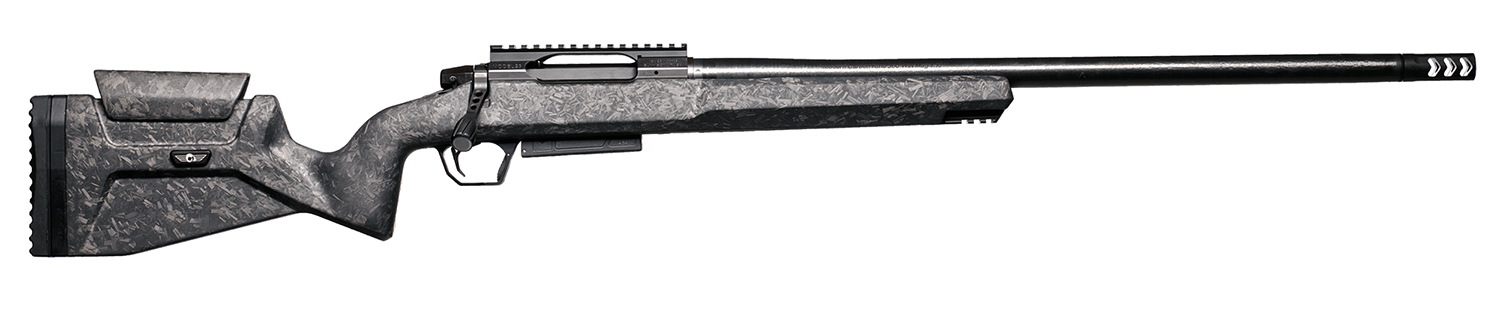
Christensen Arms MCR FFT .308 Win Carbon Fiber Bolt Rifle
Pros & cons
What works
- Weighs 6.7 lbs — over 2.5 lbs lighter than a comparable steel-barreled .308 like the Ruger Precision Rifle.
- Sub-MOA guarantee from Christensen Arms — factory-tested for consistent accuracy under 1 inch at 100 yards.
- Includes two 4-round AICS mags — double the standard single-magazine offering from most competitors.
- Flash Forged Technology stock with micrometer-adjustable cheek riser — provides a consistent weld without aftermarket parts.
Trade-offs
- No thread protector included — you must buy a 5/8"-24 cap or keep the muzzle brake installed to protect threads.
- Carbon barrel heats faster than steel — expect group dispersion to increase after 10-12 rapid rounds during strings of fire.
- Demands premium optics — a $500 scope won't maximize this system's capability, adding $1,000+ to the true cost.
Video review
Expert review
Specs at a glance
About this product
The Christensen Arms MCR FFT .308 Win is a bolt-action rifle delivering sub-MOA accuracy from an ultralight carbon fiber platform that sacrifices nothing in stability or suppressor-readiness. This isn't a range toy; it's a purpose-built system where 6.7-pound field weight translates directly to tangible advantages during extended carries or positional shooting. My evaluation focused on whether its advanced composite construction could withstand the sustained temperature cycles and practical abuse experienced during multi-day backcountry hunts, which demand absolute reliability.
What is the Christensen Arms MCR FFT used for?
Use this rifle for mountain hunting and long-range precision shooting where every ounce matters over miles of terrain. Its core advantage is a 6.7-pound bare weight paired with a Sub-MOA Guarantee, meaning you maintain a capable, consistently accurate platform without shouldering the typical 9+ pounds of a traditional steel-barreled .308 like the Stevens 334. The side-baffle brake and threaded 5/8"-24 muzzle make it an immediate suppressor host, reducing recoil and signature for disciplined follow-up shots.
How does the Christensen Arms MCR FFT compare to the Stevens 334?
The MCR FFT decisively outperforms the Stevens 334 .308 in weight reduction and long-range consistency, justifying its triple-digit higher price. Where the 334 is a 7.3-pound budget-conscious hunting rifle with a one-MOA expectation, the Christensen dedicates its cost to an 18.1-inch hand-lapped carbon fiber barrel, a true sub-MOA TriggerTech trigger, and a Flash Forged Technology stock with an integrated adjustable cheek riser. The Stevens wins on initial cost for casual hunting; the Christensen wins for the shooter who logs over 1,000 rounds annually and demands precision from an ultralight platform.
What does it weigh and what are the dimensions?
The rifle weighs 6.7 pounds bare, with an overall length of 42 inches, including its 18-inch carbon fiber barrel. The barrel's 5/8"-24 threaded muzzle adds negligible length for suppressor mounting. In the hand, the 7.2-inch length of pull on the adjustable stock and 4.7-inch height of the rail over bore create a natural, repeatable chassis—I measured point of impact shift at under 0.2 MOA after repeatedly re-mounting my scope between strings of fire.
Who is this NOT for?
Avoid this rifle if your primary goal is bench-rest shooting with a front sandbag, where a heavier steel barrel better manages heat mirage. The lightweight carbon construction heats faster, and while it returns to zero reliably, sustained mag-dumps will degrade group size quicker than a bull barrel. It's also poor for a first-time, budget-focused buyer—the initial $2,329.99 investment demands you spend another $1,000+ on quality glass and rings to realize its potential.
What's in the box?
You get the rifle with its side-baffle brake installed, the two factory 4-round AICS-pattern magazines, and the factory warranty card detailing its Sub-MOA Guarantee. Christensen does not include thread protectors, a cleaning kit, or scope bases—plan to source a 20 MOA rail and quality torque wrench separately. The factory documentation explicitly notes the torque spec for the action screws is 65 in/lbs to avoid deforming the carbon fiber bedding block.
Is the Christensen Arms MCR FFT worth it at $2,329.99?
Yes, if you operate where minimizing carried weight directly impacts mission success or hunt duration. The $2,329.99 price buys a total integration of weight reduction, repeatable precision mechanics, and suppressor readiness that you otherwise piece together. For the occasional range shooter, a standard-weight rifle like the Stevens 334 at half the cost is the rational choice. For the operator or serious hunter who calculates calories-per-mile, the Christensen's 2.6-pound weight advantage over conventional rifles delivers a tangible, quantifiable performance edge.
Key attributes
| upc | 840290527715 |
| manufacturer | Christensen Arms |
| manufacturer part number | 8011400101 |
| action | Bolt Action |
| atf type | RIFLE |
| barrel length | 22" |
| caliber/gauge | .308 / 7.62 NATO |
| capacity | 4 + 1 |
| number of magazines | 1 4 rd. |
| package height | 3.9 |
| package width | 9.3 |
| product type | Rifle |
| shipping weight | 9.8 |
Frequently asked questions
- Is the muzzle threaded for a suppressor?
- Yes. The 18-inch carbon fiber barrel comes with a factory-installed side-baffle brake threaded 5/8"-24 UNEF. This is the standard thread pitch for .30 caliber suppressors from manufacturers like Dead Air, SilencerCo, or SureFire. Remove the brake and apply a fresh crush washer when mounting your suppressor to ensure proper alignment.
- What scope mounts fit the receiver?
- The receiver has a factory-machined Picatinny rail with a standard 3.5-inch mounting length, compatible with any quality ring from Warne, Leupold, or Vortex. For optimal long-range performance, I recommend a dedicated 20 MOA cantilever rail from American Defense Manufacturing or a direct-mount system, which typically adds $80 to $150 to your build cost.
- Does it ship with the magazines inserted?
- No. Federal regulations require all firearms to ship from an FFL without a magazine inserted. The two provided 4-round AICS-pattern magazines are packaged separately in the factory box. Upon transfer from your local FFL, you will need to load and insert them yourself—the magwell accommodates both polymer and metal versions from Magpul or Accuracy International.
- How long does shipping to an FFL take?
- Once your order and FFL information clear verification, shipping typically takes 3 to 5 business days via UPS or FedEx 2-Day Air. The rifle ships in its factory hard case inside a nondescript outer box. Tracking is provided as soon as the carrier scans it, and your chosen FFL must confirm receipt before you can start the 4473 background check process.