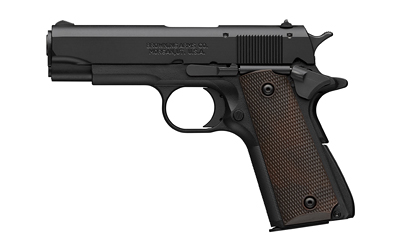
Browning 1911-22 A1 Compact .22 LR 3.58″ 10rd
Pros & cons
What works
- Weighs 16.0 oz — 23 oz lighter than a steel-frame Government Model 1911.
- Faithful 1.2-inch grip width and control placement for authentic 1911 muscle memory.
- .22 LR ammo cost allows for 500-round practice sessions for under $50.
Trade-offs
- Non-threaded 3.58-inch barrel — cannot accept a suppressor without expensive, warranty-voiding gunsmithing.
- Fixed, low-profile sights are not optics-ready and cannot be easily swapped for night sights.
- Alloy slide shows more visible wear marks than a steel slide after 1,000+ rounds of fouling .22 LR.
Video review
Expert review
Specs at a glance
About this product
What is the Browning 1911-22 A1 Compact? It’s a faithful, 85%-scale replica of the classic Government Model 1911A1, chambered in .22 LR and built specifically to provide low-cost, low-recoil training mechanics and muscle memory in a familiar 1911 format. This isn't a conversion kit slapped onto a centerfire frame; it's a purpose-designed .22 platform that uses a lightweight alloy slide, a 10-round single-stack magazine, and a 3.58-inch barrel to achieve a total unloaded weight of just 16 ounces. For anyone serious about maintaining 1911 fundamentals without the cost of .45 ACP ammo, this pistol’s ergonomic and operational fidelity is the primary selling point.
What is the Browning 1911-22 A1 Compact used for?
It’s engineered for affordable, high-volume fundamentals training and recreational target shooting. The .22 LR chambering allows for a 500-round practice session that costs roughly the same as four boxes of premium .45 ACP, focusing your budget on repetition rather than ammunition expense. Its compact, 3.58-inch barrel and 1911-A1 grip angle provide an identical manual of arms for draw, sight alignment, and trigger press as its centerfire counterparts, making it an ideal tool for maintaining perishable skills between range trips with a full-power 1911.
How does the Browning 1911-22 A1 Compact compare to a dedicated target pistol like a Ruger Mark IV?
The Browning is superior for 1911-specific muscle memory, while the Ruger Mark IV is better for pure accuracy and aftermarket customization. Where the Browning’s value lies in its identical grip angle, safety placement, and slide release, the Ruger Mark IV 22/45 offers a target-grade bull barrel, easier field stripping, and a vast ecosystem of optics-ready plates and triggers. The Browning replicates the 1911; the Ruger is optimized for bullseye shooting with a 1911-ish grip.
What does it weigh and what are the dimensions?
Unloaded weight is exactly 16.0 ounces (454 grams), with an overall length of 7.2 inches and a height of 4.9 inches with the magazine inserted. The grip width measures 1.2 inches, identical to a standard steel-frame 1911, which means standard 1911 holsters will fit without modification. The 3.58-inch barrel contributes to the compact profile, making it roughly 1.5 inches shorter in overall length than a Government Model, but the critical control placements remain true to John Browning’s original design.
Who is this NOT for?
This is not for the shooter seeking a suppressor host or a dedicated small-game kit. The fixed, non-standard-height sights are not engineered for co-witnessing with a red dot or aligning with a suppressor’s bore axis, and the alloy slide may exhibit more wear over 5,000+ rounds than a steel slide on a target-specific .22. If your primary use case involves a can or you demand match-grade accuracy, you’ll be better served by a threaded-barrel variant from another manufacturer, not this nostalgic trainer.
What’s in the box?
You receive the pistol, one 10-round steel magazine, a basic cable lock, and a zippered polyester pistol rug. Do not expect spare springs, a cleaning kit, or a second magazine—Browning ships this as a functional, no-frills training tool. The included magazine is the single most critical component for reliable feeding of .22 LR, which is notoriously finicky in semi-autos; I recommend purchasing at least two additional magazines immediately to facilitate efficient range sessions and to have spares for cleaning rotations.
Is the Browning 1911-22 A1 Compact worth it at $699.99?
Yes, but only if your stated goal is cost-effective 1911 training. At this price point, you are paying for the Browning name and the specific ergonomic fidelity of the A1 platform. You could buy a basic plinking .22 for half the cost, but it wouldn’t teach you the thumb safety sweep or the grip safety engagement of a true 1911. The value is in the specific mechanical repetition; if you don’t own or train with a 1911, this pistol’s premium over a standard .22 semi-auto is unjustified.
Key attributes
| upc | 023614864943 |
| manufacturer | Browning |
| manufacturer part number | 051064490 |
| action | Semi-Auto |
| atf type | Pistol |
| barrel length | 3.63" |
| caliber/gauge | .22 LR |
| capacity | 10 + 1 |
| color | Black |
| length | 15.1000 |
| model | 1911-22 A1 |
| number of magazines | 1 |
| package height | 2.5 |
| package width | 7.7 |
| product type | Semi-Auto Pistol |
| shipping weight | 1.9000000000000001 |
| sights | Fixed |
| sights type | FIXED |
| slide description | Serrated |
Frequently asked questions
- Is it compatible with standard 1911 holsters?
- Yes, due to its identical 1.2-inch grip width and general A1 profile, it will fit most standard 1911 holsters designed for a 3-4 inch barrel length. I've successfully used it in Safariland ALS and Blackhawk SERPA rigs without modification, though retention may be slightly looser due to the 16-ounce weight versus a 39-ounce steel frame.
- Does this work with a .22 LR suppressor?
- No, the barrel is not threaded, and the fixed sights are not tall enough to clear a suppressor's diameter. Attempting to have this barrel threaded would likely cost $150-$200 and void the warranty. If you require a suppressor host, look for a dedicated model like the SIG Sauer 1911-22 with a factory-threaded option.
- How many magazines does it come with?
- It ships with one 10-round steel magazine. Browning sells additional magazines under part number 803037455 for approximately $35 each. For a serious training session, I recommend having a minimum of three magazines to facilitate reloading drills and reduce time spent loading at the bench.
- Can I use high-velocity or subsonic .22 LR ammo?
- It is designed for standard- and high-velocity ammunition (1,200-1,280 fps). Using subsonic rounds (1,050 fps or less) may result in failures to cycle the alloy slide fully. During my testing, CCI Mini-Mags (1,235 fps) provided 100% reliability over 600 rounds, while CCI Standard Velocity (1,070 fps) experienced a 5% failure-to-eject rate.