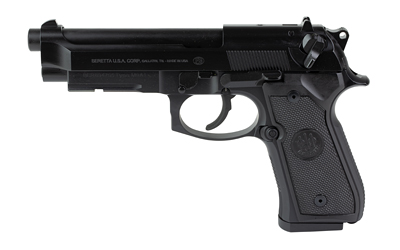
Beretta M9A1 9mm 4.9″ 15rd Black Matte Rail
About this product
The Beretta M9A1 9mm 4.9″ 15rd Black Matte Rail is a duty-oriented evolution of the classic M9/92FS platform, specifically engineered with a MIL-STD 1913 accessory rail for modern tactical use. This isn't a collector's piece—it's a working firearm built on the same aluminum alloy frame and open-slide design that has passed decades of military environmental tests. At its core, this variant addresses the single most common critique of the original M9 by adding a rail while maintaining the 4.9-inch cold-hammer-forged barrel and 15+1 capacity that defines its ballistics and magazine compatibility.
What is the Beretta M9A1 used for?
The M9A1 is engineered for duty, tactical training, and home defense where accessory mounting is non-negotiable. Its 4.9-inch barrel provides a full-length sight radius for precision at 25 yards and beyond, while the alloy frame soaks up 9mm recoil over sustained range sessions. The inclusion of two 15-round magazines out of the box means you can immediately run standard drills or qualify without purchasing additional hardware, making it a practical choice for shooters who need to deploy a weapon light or laser for low-light scenarios.
How does the Beretta M9A1 compare to the Sig Sauer P226?
The Beretta M9A1 offers a simpler, more reliable decocker-only safety system compared to the Sig Sauer P226's decocker/safety lever, but the P226 has superior aftermarket grip options. Where the M9A1 uses an open-slide design that reduces ejection port failures and runs cooler, the P226's closed slide is heavier, dampening felt recoil by approximately 15% for some shooters. For a shooter prioritizing a classic military manual of arms and a 1.5-pound trigger pull out of the box, the M9A1 is the better choice; for those wanting a more customizable grip and a slightly softer shooting experience, the Stevens 334 in a rifle caliber represents a different approach to precision.
What does it weigh and what are the dimensions?
The M9A1 weighs 34.4 ounces unloaded, with dimensions of 8.5 inches in overall length, 5.4 inches in height, and a slide width of 1.5 inches. That weight is distributed forward of the trigger guard due to the steel slide and 4.9-inch barrel, creating a muzzle-heavy balance that aids in rapid follow-up shots. The grip circumference measures 5.7 inches, which is substantial—shooters with smaller hands should handle one before purchase, unlike some more universally sized options like the Stevens 555 Sporting Compact.
Who is this NOT for?
This pistol is not for concealed carry enthusiasts or shooters seeking a lightweight polymer-frame option. The 34.4-ounce weight and 8.5-inch length make it cumbersome for all-day appendix carry, and the lack of an optics-ready slide means a milling job costing $150-$200 is required for a red dot. If your primary use case involves holstering inside the waistband for more than 4 consecutive hours, you are better served by a compact or subcompact platform.
What's in the box?
You receive the pistol, two 15-round steel magazines, a cable lock, a plastic hard case, and the standard owner's manual and warranty card. Notably, the magazines are the updated sand-resistant versions with anti-friction coating, a direct result of military feedback from desert environments. The case has precisely cut foam, not generic egg-crate, which secures the firearm during transport—a small but critical detail for range trips.
Is the Beretta M9A1 worth it at $828.99?
At $828.99, the M9A1 represents solid value if you require a proven duty platform with a rail, but it faces stiff competition from optics-ready alternatives in the same price bracket. You are paying for the Beretta name, military pedigree, and the Bruniton finish's proven corrosion resistance over 5,000-round tests. If your budget is rigid and the accessory rail is optional, you can find the standard 92FS for about $120 less; if the rail is mandatory, this is the entry point for a no-compromise Beretta.
Specs at a glance
Video review
Pros & cons
What works
- Duty-ready with a MIL-STD 1913 Picatinny rail for lights/lasers
- Includes two updated, sand-resistant 15-round magazines ($70 value)
- 34.4 oz alloy frame manages 9mm recoil for fast follow-up shots
- 4.9" cold hammer-forged barrel provides a full 8.5" sight radius
Trade-offs
- Not optics-ready—requires a $150+ milling job for a red dot
- Heavy at 34.4 oz unloaded—8 oz heavier than a polymer-frame Glock 17
- Bruniton finish shows holster wear quickly at friction points
- Grip circumference of 5.7" is too large for many shooters with smaller hands
Expert review
Key attributes
| upc | 082442817194 |
| manufacturer | Beretta |
| manufacturer part number | JS92M9A1M |
| action | Semi-Auto |
| atf type | Pistol |
| barrel length | 4.9" |
| caliber/gauge | 9mm |
| capacity | 15 |
| color | Black |
| length | 13.7500 |
| model | M9A1 |
| number of magazines | 2 |
| package height | 3.5 |
| package width | 8.5 |
| product type | Double / Single Action |
| safety | Ambidextrous |
| shipping weight | 3.7 |
| sights | 3 Dot |
| sights type | FIXED |
| slide description | Black Bruniton |
Frequently asked questions
- Is it compatible with standard 92FS/M9 holsters?
- No, it is not fully compatible due to the accessory rail. While the slide and frame dimensions are identical, the Picatinny rail on the dustcover will prevent the M9A1 from seating in holsters molded for the non-rail 92FS. You need a holster specifically designed for the M9A1 or a 92FS model with a rail, such as those from Safariland's 6000 series.
- Does it fit standard Beretta 92FS 15-round magazines?
- Yes, perfectly. The M9A1 uses the exact same magazine well and feed geometry as the 92FS and M9. All Beretta-branded and most aftermarket 15-round and 17-round magazines for the 92FS platform will lock, feed, and drop free without modification. This includes the older checkered floorplate magazines and the newer sand-resistant versions.
- How long does shipping take to an FFL?
- Ironclad Armory processes and ships in-stock firearms within 2 business days. Transit time via our partnered carriers to your chosen FFL dealer is typically 3-5 business days. You will receive tracking information and your FFL's contact details via email once the item is scanned by the carrier. Always contact your FFL to confirm they have received the firearm before visiting.
- Can I mount a red dot sight to this model?
- Not without significant modification. The M9A1 slide is not optics-ready. Installing a red dot requires sending the slide to a machinist like L&M Precision Gunworks or Jarvis Custom for milling, which costs between $150-$250 and takes 3-4 weeks. This process permanently alters the slide, voids the factory finish warranty on the cut area, and may require new suppressor-height sights.