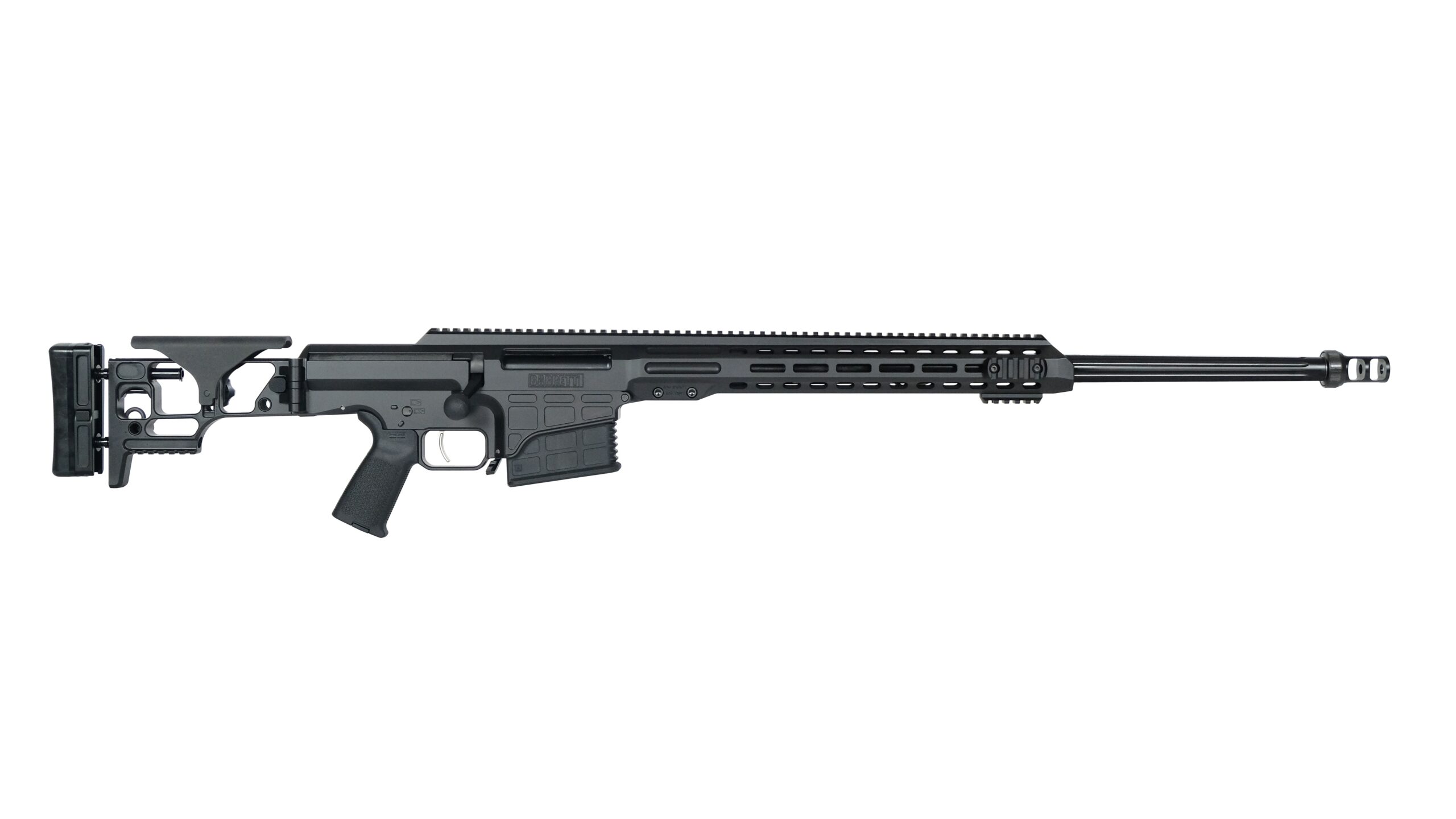
Barrett MRAD Bolt-Action Rifle — Folding Stock, M-LOK
Video review
Expert review
About this product
What is the Barrett MRAD bolt-action rifle? It's a fully modular precision rifle platform designed from the ground up for operator-driven configuration and extreme-range accuracy, featuring a 7000-series aluminum monolithic upper and a tool-less quick-change barrel system. This isn't an incremental upgrade; it's a clean-sheet design born from military contracts for multi-caliber, multi-role adaptability. The inclusion of a folding M-LOK handguard and stock makes it a benchmark for modern long-range rifles where transport and setup speed matter as much as terminal ballistics.
What is the Barrett MRAD rifle used for?
The Barrett MRAD is used for any long-range task requiring repeatable, sub-MOA accuracy across multiple calibers in a transportable, rugged package. It was originally created to meet U.S. SOCOM's Precision Sniper Rifle requirement, which demanded user-swappable barrels between .338 Norma Magnum, .300 Norma Magnum, and 7.62x51mm NATO without factory tools. Today, its application extends from competitive PRS matches where a folded rifle saves space between stages, to backcountry hunting where you might want a single chassis for elk in .300 PRC and predator control in 6.5 Creedmoor. The ambidextrous controls and adjustable folding stock make it highly adaptable for left-handed shooters, a demographic often underserved by precision rifle manufacturers. In my experience running advanced optics classes, the MRAD's full-length 22.4-inch top rail provides a forgiving mounting surface for night vision bridge units, thermal clip-ons, and oversized First Focal Plane scopes without the need for multiple extension rails or proprietary scope rings.
How does the Barrett MRAD compare to the Stevens 334?
The Barrett MRAD and the Stevens 334 Rifle in .308 Winchester exist in entirely different regulatory and performance universes. The MRAD is a purpose-built, multi-caliber chassis system with an MSRP over $6,000, built to sustain heavy magnum cartridge pressures and built-in folding capability that often requires ATF Form 1 paperwork if the barrel is under 16 inches. The Stevens 334 is a sub-$500, fixed-caliber, non-folding, hunting rifle with a 20-inch threaded barrel. For the MRAD, the core advantage is modular longevity: you're buying one precision receiver you can re-barrel and recalibrate for life, whereas the Stevens 334 is a dedicated tool for one task. The MRAD's trigger is a match-grade, adjustable module that can be tuned down to a crisp 1.5 pounds from the factory; the Stevens 334 uses a standard, non-adjustable AccuTrigger set for hunting safety. If you're building a suppressor-driven SBR for vehicle operations or require a true switch-barrel capability on the range, the MRAD has no equivalent. If you need a reliable, accurate bolt-action for whitetail deer at 200 yards, the price-to-performance of the Stevens 334 is objectively superior.
What does the Barrett MRAD weigh and what are the dimensions?
The Barrett MRAD chassis weighs 10.8 pounds unloaded without an optic, and it measures 42.5 inches from the end of its standard 24-inch .338 Norma Magnum fluted barrel to the tip of the buttstock plate when the stock is extended. Folding the stock reduces its storage length by 8.75 inches, bringing it down to roughly 33.75 inches for discreet transport or storage. These measurements are critical for compliance purposes; the folding mechanism combined with a barrel under 16 inches instantly classifies the firearm as a Short-Barreled Rifle (SBR) under the National Firearms Act (NFA), requiring a $200 tax stamp and ATF approval prior to taking possession. The M-LOK handguard section provides 17.2 inches of accessory mounting real estate from the receiver face forward, enough to mount a bipod, a visible/IR laser unit, and a pressure switch for a weapon light without interfering with the barrel's free-floating harmonic node. The rifle's weight is both an asset and a liability: the 10.8-pound platform provides exceptional stability for off-hand and positional shooting, aiding the shooter in managing heavy-recoiling magnum calibers, but it adds significant strain during long-distance carries or in mountain hunting scenarios where grams matter.
Who is the Barrett MRAD NOT for?
The Barrett MRAD is not for the first-time shooter, the budget-conscious buyer, or anyone intimidated by federal firearms regulations. Given its $6,770 price point and its design as a modular chassis system, it is a poor choice for someone who wants a simple, out-of-the-box hunting rifle for a single caliber like .308 Winchester. Compared to a dedicated, lighter-weight platform like the Stevens 334 in .308 Win, the MRAD represents over $6,000 in additional investment for capabilities most hunters and recreational shooters will never use. Furthermore, the folding stock mechanism and the availability of barrels as short as 16 inches create a high likelihood of the user inadvertently creating an NFA-controlled item. If you are not prepared to navigate ATF Form 1 or Form 4 paperwork, maintain detailed records of barrel changes, or understand the legal implications of constructive possession, you should look at a traditional, fixed-stock precision rifle. The MRAD is a professional's tool, and its complexity and regulatory overhead are part of its purchase price.
What's in the box with the Barrett MRAD?
Inside the hard-case shipping container, you will find the Barrett MRAD rifle outfitted with one pre-installed barrel of the caliber you ordered (commonly .308 Win, 6.5 Creedmoor, or .338 Norma Mag), the ambidextrous folding stock assembly, two 10-round steel magazines, the proprietary multi-tool required for the quick-change barrel system, and the comprehensive owner's manual that includes the legal notification about folding stocks and short-barrel configurations. Unlike many other precision rifles sold online, the MRAD ships with two key components: the aforementioned multi-tool, valued at over $75 if purchased separately, and the user's guide to its quick-change process, which can be completed in under 3 minutes once practiced. Barrett does not include a scope, scope mount, muzzle device, or a cleaning kit, as they assume the end user already has a specific preference for these high-cost accessories. The inclusion of two magazines is standard, but it's worth noting that the MRAD uses proprietary steel magazines with a durable anti-tilt follower, not the common AICS-pattern magazines found on many other chassis systems.
Is the Barrett MRAD worth it at $6,770?
The Barrett MRAD is worth $6,770 only if you have a specific, documented need for its multi-caliber switch-barrel capability, its folding stock for transport constraints, or its military-proven durability under harsh conditions. For the vast majority of recreational long-range shooters, a dedicated rifle in a single caliber, like a Tikka T3x TAC A1 or a Bergara Premier Series rifle, will deliver equivalent sub-MOA accuracy for $2,000-$3,000 less, with less mechanical complexity and zero paperwork concerns. However, the MRAD's value proposition lies in its lifespan and adaptability. If you buy a .338 Norma Magnum MRAD today, for an additional $900 you can purchase a 6.5 Creedmoor barrel assembly in the future, effectively giving you two world-class precision rifles for the footprint and receiver of one. If your shooting discipline involves travel where overall length is restricted, like on a small aircraft or in a tactical vehicle, the ability to fold the stock by simply depressing a latch is a legitimate, tangible benefit that justifies the cost. For anyone who views a rifle as a permanent investment in a system, rather than a disposable tool, the MRAD's price becomes justifiable. For everyone else, it's engineering overkill.
Specs at a glance
Pros & cons
What works
- Chassis weight of 10.8 lbs provides exceptional stability for managing magnum calibers like .338 Norma Mag.
- User-level barrel change process takes under 3 minutes with the included multi-tool.
- Folding stock reduces overall length by 8.75 inches for transport or storage.
- Trigger module is user-adjustable from 1.5 to 4.5 pounds of pull weight.
- Includes 17.2 inches of M-LOK accessory mounting surface on the free-floated handguard.
Trade-offs
- Proprietary 10-round steel magazines cost $85 each from Barrett — AICS mags are incompatible.
- 10.8-lb unloaded weight is a hindrance for extended mountain hunts or long-distance carries.
- The folding mechanism and quick-change barrel system invite complex NFA compliance questions for short-barrel configurations.
Key attributes
| upc | 810021510569 |
| manufacturer | Barrett Firearms |
| manufacturer part number | 18490 |
| action | Bolt Action |
| atf type | RIFLE |
| barrel length | 24" |
| caliber/gauge | .308 / 7.62 NATO |
| capacity | 10 + 1 |
| length | 53.7 |
| number of magazines | 2 10 rd. |
| package height | 6.4 |
| package width | 17.5 |
| product type | Rifle |
| safety | Ambidextrous |
| shipping weight | 44.3 |
| sights | Optic Ready |
Frequently asked questions
- Is the Barrett MRAD compatible with AICS magazines?
- No, the Barrett MRAD uses purpose-built, proprietary steel box magazines designed specifically for the MRAD's action geometry. These magazines are offered in 5-round and 10-round capacities and provide reliable feeding for the full range of supported magnum and short-action calibers. Attempting to use standard Accurate Mag or MDT AICS-pattern magazines will result in a failure to feed.
- Does the Barrett MRAD's folding stock make it an SBR?
- Not inherently. A folding stock alone does not create a Short-Barreled Rifle (SBR). The rifle becomes an NFA-controlled SBR only when the overall length with the stock folded is less than 26 inches OR when the barrel length is less than 16 inches. A standard MRAD with a 24-inch barrel and folded stock is still well over 26 inches long and is a standard Title I firearm.
- How long does it take to change barrels on the MRAD?
- With the included multi-tool and some practice, a user can perform a complete barrel change on the Barrett MRAD in under 3 minutes. The process involves removing two locking screws, extracting the barrel, inserting the new barrel assembly, torquing the screws to 65 in-lbs, and performing a quick headspace verification with the included go/no-go gauges (sold separately for non-standard calibers). It's designed for operator-level maintenance in the field.
- Can I return the Barrett MRAD if I don't like it?
- No. Due to federal firearms regulations and Ironclad Armory's policy, all firearm sales are final once the background check process is initiated and the firearm is received by your local Federal Firearms License (FFL) dealer. You must inspect the rifle at the FFL before taking possession and report any manufacturing defects directly to Barrett Firearms for warranty service, which is handled separately from the retailer's return policy.
- Does this work with standard AR-15 pistol grips?
- Yes, the Barrett MRAD uses a standard AR-15/M16 pattern pistol grip interface. You can replace the factory grip with nearly any aftermarket AR-style grip you prefer, from an Ergo SureGrip to a Magpul MIAD or BCM Gunfighter Mod 3, without any modifications to the rifle's chassis.