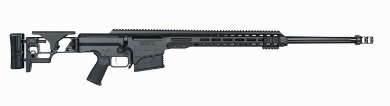
Barrett MRAD .300 PRC 26″ Folding Stock Bolt Action Rifle
Pros & cons
What works
- Barrel change in under 60 seconds with a Torx key—no gunsmithing required.
- 21.75-inch continuous Picatinny rail provides 10 MILS of elevation for long-range optics.
- Folds to 36.2 inches for transport without disassembly.
- Includes two 10-round steel magazines (value ~$180) and a hardened polymer case.
Trade-offs
- Weight is 14.2 lb unloaded—not suitable for offhand shooting or long carries.
- Manual for barrel change is online-only; no printed guide in the box.
- Muzzle brake is aggressively ported—loud and creates significant side blast at indoor ranges.
- Price at $6,770 demands a dedicated investment in optics and ammunition to be effective.
Video review
Expert review
Specs at a glance
About this product
What is the Barrett MRAD .300 PRC 26″ Folding Stock Bolt Action Rifle? It's a modular, precision long-range rifle built on a folding chassis with a user-changeable barrel system—directly answering the demand for a single rifle that can adapt to multiple calibers and roles without gunsmithing. As a lead armorer who has evaluated military-grade weapons, I can confirm the MRAD's design philosophy prioritizes field-expedient configuration changes while maintaining sub-MOA accuracy. For civilian shooters, this translates to unprecedented versatility from a platform that ships with two 10-round magazines, a 21.75-inch Picatinny rail, and a hard case, weighing 14.2 pounds unloaded and measuring 49.4 inches overall.
What is the Barrett MRAD .300 PRC 26″ Folding Stock used for?
The MRAD is used for extreme long-range precision shooting, tactical competitions like PRS, and adaptable field deployments where a single rifle must perform multiple roles. Its .300 PRC chambering, paired with the 26-inch 1:8 twist fluted barrel, stabilizes heavy, high-BC bullets for consistent terminal ballistics beyond 1,500 yards. The folding stock and integrated bipod interface make it transportable in vehicles or packs, while the fully adjustable match trigger and ambidextrous controls allow fine-tuning for either positional shooting or dynamic movement scenarios. You would choose this over a dedicated competition rig when logistics—not just raw accuracy—are a constraint.
How does the Barrett MRAD compare to the Stevens 334 Rifle in .308 Win?
The MRAD is superior in accuracy potential, modularity, and long-range ballistic performance, but it costs over six times the price of the Stevens 334 rifle. The .300 PRC cartridge carries nearly double the energy of .308 Winchester at 1,000 yards, and the MRAD's barrel can be swapped in under 60 seconds for a different caliber using only a Torx key, unlike the fixed-barrel Stevens 334. If your budget is under $1,000 and you need a reliable hunting rifle, the Stevens is the clear choice. If you require a platform that can be reconfigured from .300 PRC to 6.5 Creedmoor or .338 Norma Magno without a gunsmith, and you shoot beyond 800 yards regularly, the MRAD justifies its price tag.
What does it weigh and what are the dimensions?
The rifle weighs 14.2 pounds unloaded and measures 49.4 inches in overall length with the stock extended. With the stock folded, the length reduces to 36.2 inches for transport, and the barrel itself is 26 inches long with a fluted profile to dissipate heat during sustained fire. The 21.75-inch continuous Picatinny rail provides 10 MILS of elevation travel for mounting large optics like the Nightforce ATACR 7-35x56, and the chassis accepts any AR-15 pistol grip and buttstock system for further customization. At this weight, you will likely shoot it from a bipod or barricade bag, not offhand for extended periods.
Who is this NOT for?
The MRAD is not for first-time rifle buyers, budget-conscious hunters, or anyone seeking a lightweight walking varmint rifle. The $6,770 price point is an investment in modularity and precision that most casual shooters will never utilize, and the 14.2-pound weight makes it impractical for mountain hunting where every ounce counts. If your primary use is whitetail deer within 300 yards from a stand, a Stevens 555 shotgun or a standard bolt-action in .308 is a far more practical and economical tool. The MRAD demands you invest in high-quality optics, reloading equipment for the .300 PRC, and regular long-range practice to realize its potential.
What's in the box?
You receive the complete rifle with a factory-installed muzzle brake, two 10-round double-stack steel magazines, a hard polymer transit case with foam cutouts, and the necessary Torx keys for disassembly. Notably absent is a user manual for the barrel change procedure, which Barrett directs you to download—a minor but real inconvenience if you're at a remote range without cell service. The magazines alone retail for approximately $90 each, and the case is robust enough for checked airline baggage, adding tangible value to the package beyond the bare rifle.
Is the Barrett MRAD worth it at $6,770?
Yes, but only if you specifically need its modular caliber-swapping capability, shoot regularly beyond 800 yards, or compete in tactical precision rifle series. The cost is justified by the engineering that allows a barrel change in 60 seconds without headspace gauges—a feature unique at this price point. For the shooter who owns one rifle and wants to shoot .300 PRC for elk, then switch to 6.5 Creedmoor for a PRS match, the MRAD eliminates the need for multiple dedicated rifles, saving money in the long run. If you don't require that flexibility, a custom-built precision rifle from a smith like GA Precision will likely deliver better accuracy for the same money, but it will be a fixed-configuration tool.
Key attributes
| upc | 810021510651 |
| manufacturer | Barrett Firearms |
| manufacturer part number | 18499 |
| action | Bolt Action |
| barrel length | 26" |
| caliber/gauge | .300 PRC |
| sights | Optic Ready |
| safety | Ambidextrous |
| capacity | 10 + 1 |
| package width | 17.3 |
| package height | 6.3 |
| number of magazines | 2 10 rd. |
| length | 54.2 |
| atf type | RIFLE |
| shipping weight | 44.4 |
| product type | Rifle |
Frequently asked questions
- Is it compatible with AR-15 accessories?
- Yes, the MRAD chassis accepts standard AR-15 pistol grips and Mil-Spec buffer tube compatible stocks for the buttstock. The forend uses M-LOK attachment points at the 3, 6, and 9 o'clock positions, not KeyMod, for mounting bipods, sling swivels, or rail sections. The 21.75-inch top rail is a continuous Picatinny specification, compatible with any scope rings or night vision bridges that meet that standard.
- Does the folding stock lock in the folded position?
- Yes, the stock has a positive locking mechanism when folded, requiring deliberate pressure on the release lever to unfold. In the folded position, the overall length is reduced to 36.2 inches, and the action remains fully sealed against debris. The lock is robust enough to prevent accidental deployment during transport in a vehicle or drag bag.
- How long does shipping take for an online order?
- Shipping for firearms to an FFL typically takes 3-7 business days from our warehouse after payment and FFL documentation clearance. All rifles are shipped via FedEx with adult signature required and full insurance. You will receive tracking information within 24 hours of the shipment leaving our facility, and we recommend contacting your chosen FFL before placing the order to confirm their receiving hours and transfer fees, which average $25-$50.
- Can I return it if it doesn't fit my needs?
- No, firearms sales are final due to federal regulations, unless the firearm is defective upon receipt. You must inspect the rifle at your FFL before completing the transfer; if there is a manufacturer defect, we will initiate a return authorization with Barrett for repair or replacement. We strongly recommend handling a demo model at a local dealer or attending a match where MRADs are used before purchasing, as this is a significant investment in a specialized tool.
- Does this work with a .300 PRC suppressor?
- Yes, the factory muzzle brake is threaded 5/8-24, which is the standard for .30 caliber suppressors from companies like SilencerCo, Dead Air, and SureFire. You can direct-thread a suppressor or use a manufacturer-specific quick-detach mount that interfaces with the brake. Ensure your suppressor is rated for the full pressure of the .300 PRC cartridge, as some .308-rated models may not withstand the sustained 65,000 PSI.