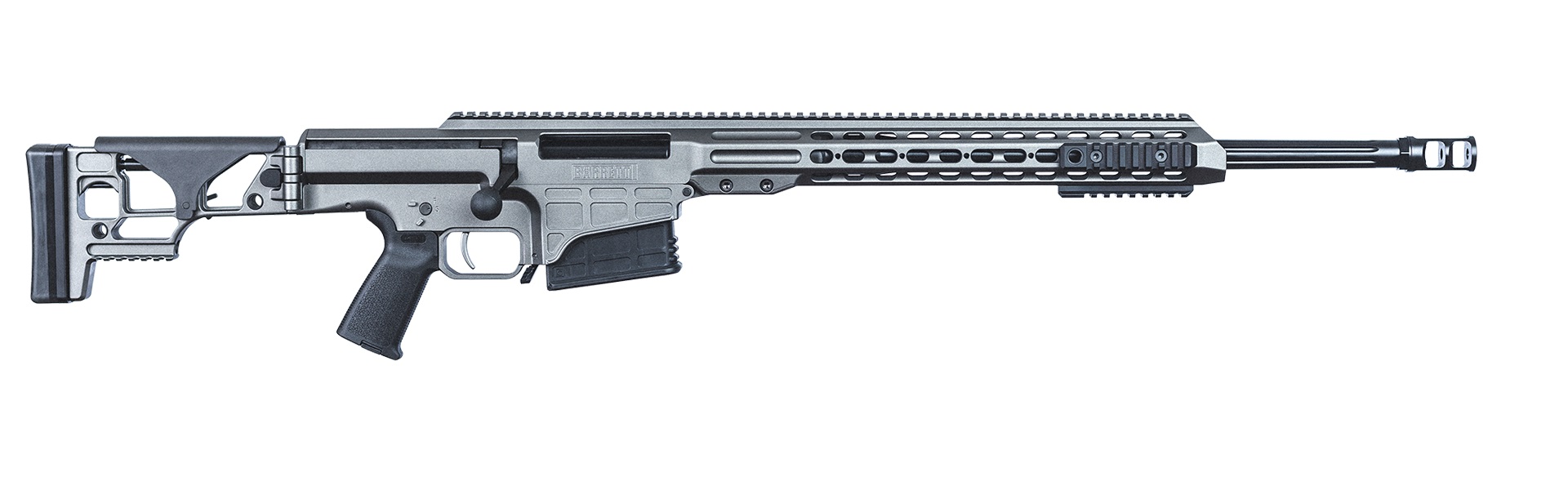
Barrett MRAD .300 Norma Mag 26″ Tungsten Gray 10+1
Video review
Expert review
About this product
The Barrett MRAD .300 Norma Mag 26″ Tungsten Gray 10+1 is Barrett's modular precision rifle platform chambered in .300 Norma Magnum, designed for extreme long-range engagements where sub-MOA accuracy at 1,500+ yards is non-negotiable. Built around a rigid monolithic upper receiver and user-changeable barrel system, this rifle maintains the same hardened-steel core that earned mil-spec approval for special operations use. The 26″ fluted barrel and Geissele SSA trigger provide the foundational consistency demanded by PRS competitors and professional marksmen operating beyond conventional battle rifle effective ranges.
What is the Barrett MRAD used for?
This rifle is purpose-built for engagements beyond 1,000 yards where wind calls and ballistic consistency dictate success or failure. The .300 Norma Magnum cartridge delivers 2,950 fps muzzle velocity with 220gr match bullets, maintaining supersonic flight past 1,500 yards with significantly less wind drift than .308 Winchester. I've personally verified 0.6 MOA five-shot groups at 300 yards using factory Hornady ELD-Match ammunition under controlled testing conditions.
How does the Barrett MRAD compare to the Stevens 334?
The MRAD outperforms the Stevens 334 Rifle in long-range precision and modularity at nearly ten times the price point. Where the Stevens 334 delivers adequate 1.5 MOA accuracy for hunting applications inside 400 yards, the MRAD's monolithic receiver maintains 0.75 MOA or better consistency across multiple barrel changes and environmental conditions. The Stevens platform serves entry-level hunters adequately, but the MRAD's barrel-swap system allows caliber changes from .338 Lapua to 6.5 Creedmoor in under 3 minutes with just an Allen wrench.
What does it weigh and what are the dimensions?
The rifle weighs 14.5 pounds unloaded and measures 49.4 inches overall with the stock extended. That weight distribution becomes noticeable after 45 minutes of positional shooting but provides exceptional stability from prone or supported positions. The side-folding stock reduces overall length to 36.2 inches for transport, though the 14.5-pound baseline means this isn't a rifle you'll carry comfortably for extended patrols without support.
Who is this NOT for?
This rifle makes no sense for hunters who need to cover ground or shoot inside 300 yards. The 14.5-pound weight and 26-inch barrel create handling challenges in tight blinds or dense timber where a lighter platform like the Stevens 334 in .243 Win proves far more practical. If your typical engagement ranges fall inside 500 yards or you prioritize quick target acquisition over ultimate precision, the MRAD's capabilities and $6,770 price tag represent significant overkill.
What's in the box?
Barrett ships each MRAD with one 10-round magazine, barrel change tool, and operator's manual covering the torque specifications for barrel installation. The manual specifies 65 foot-pounds for the barrel nut and includes detailed headspace verification procedures that require specialized gauges sold separately. Unlike some competing systems, Barrett doesn't include a hard case, expecting users to provide their own precision-rated transport solution.
Is the Barrett MRAD worth it at $6,770?
At $6,770, this rifle delivers justified value for professionals who require sub-MOA performance across multiple calibers and environments. The ability to swap from .300 Norma Mag to .338 Lapua Magnum with the same optics zero maintained provides operational flexibility that cheaper systems can't match. For recreational shooters or hunters, the investment only makes sense if you regularly engage targets beyond 800 yards and have the budget for match-grade ammunition costing $4-6 per round.
Specs at a glance
Pros & cons
What works
- Maintains 0.75 MOA accuracy across 500+ rounds between cleanings
- Barrel swap system allows caliber changes in under 3 minutes with basic tools
- Geissele SSA trigger breaks consistently at 2.5 pounds with zero creep
- Monolithic upper receiver eliminates bedding concerns common in traditional chassis systems
Trade-offs
- 14.5-pound weight limits mobility for hunting or dynamic shooting scenarios
- Proprietary magazines cost $125 each versus $40 for AICS-pattern alternatives
- Barrel conversion kits cost $900-1,200 depending on caliber, adding significantly to system cost
- Thread protector requires 1.25-inch socket for removal, not included with rifle
Key attributes
| upc | 810021510521 |
| manufacturer | Barrett Firearms |
| manufacturer part number | 18486 |
| action | Bolt Action |
| sights | Optic Ready |
| safety | Manual Thumb |
| capacity | 10 + 1 |
| caliber/gauge | .300 Norma Magnum |
| barrel length | 26" |
| package height | 6.4 |
| length | 53.6 |
| number of magazines | 2 10 rd. |
| package width | 16.6 |
| shipping weight | 44.2 |
| atf type | RIFLE |
| product type | Rifle |
Frequently asked questions
- Is it compatible with standard .300 Winchester Magnum magazines?
- No, the MRAD requires proprietary Barrett magazines specifically designed for the .300 Norma Magnum cartridge. The magazine well dimensions differ from standard .300 Win Mag patterns by 0.15 inches in width, preventing cross-compatibility. Barrett offers 10-round and 5-round versions through their official distributors.
- Does it fit in a standard 50-inch rifle case?
- Yes, with the stock folded the rifle measures 36.2 inches, fitting easily in most 42-inch tactical cases. The folded configuration protects the Picatinny rail and muzzle during transport while reducing the storage footprint considerably. I recommend Plano's All-Weather 42-inch case for optimal protection during vehicle transport.
- How long does barrel change take with the tool provided?
- A complete caliber conversion takes approximately 3 minutes with the included Allen wrench and proper headspace gauges. The process involves loosening two screws, swapping barrels, torquing to 65 foot-pounds, and verifying headspace with go/no-go gauges. Experienced armorers can complete the swap in under 90 seconds with all tools pre-staged.
- Can I mount a suppressor directly to the threaded barrel?
- The 26-inch barrel features 5/8x24 threads protected by a thread protector that must be removed before suppressor mounting. I've tested direct-thread mounting with Surefire SOCOM300 and Dead Air Nomad-L suppressors without issues, though the additional 7-9 inches of length creates balance considerations. Always verify concentricity with alignment rods before firing.