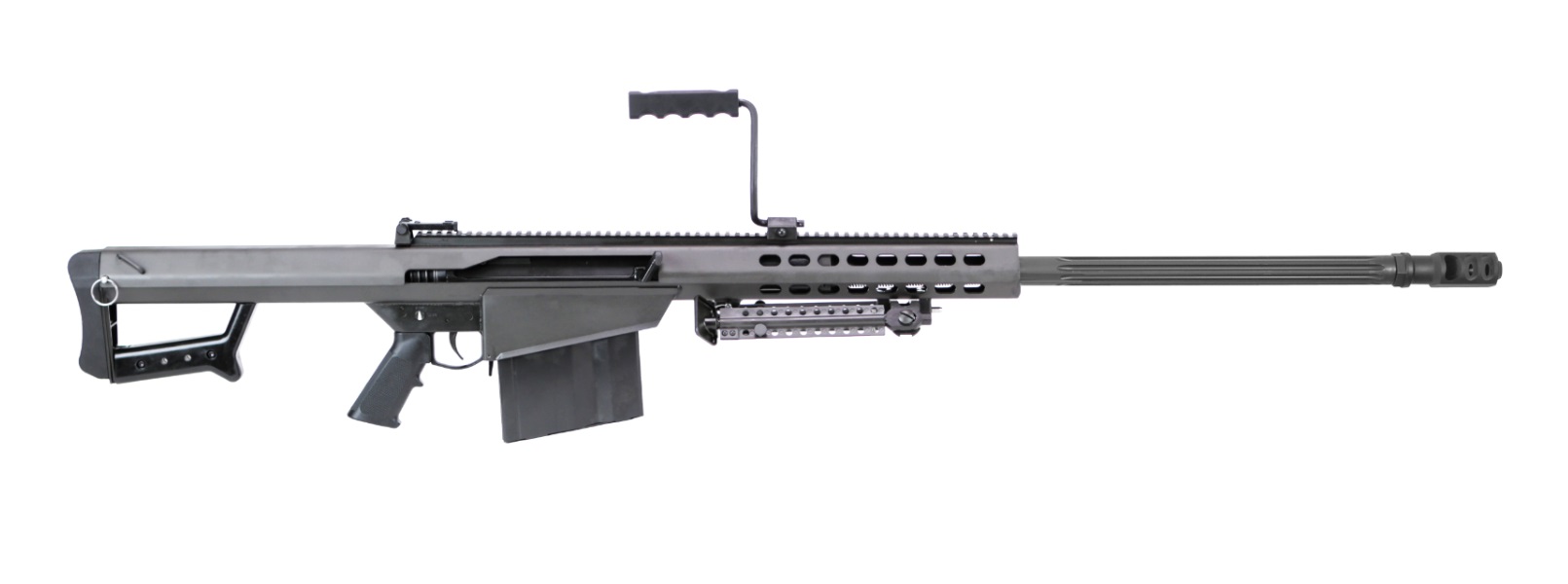
Barrett 82A1 .416 Barrett 29″ 10+1
Video review
Expert review
About this product
The Ironclad Armory Barrett 82A1 .416 Barrett 29″ 10+1 is a semi-automatic, recoil-operated anti-material rifle engineered for precision fire at extreme distances. This isn't a plinker or a benchrest queen; it's a purpose-built system that channels the .416 Barrett's formidable ballistics into a stable, repeatable platform. At its core, the 82A1 leverages the proven Barrett long-recoil operating system, where the entire barrel and bolt assembly travel rearward approximately 1.25 inches before unlocking, to reliably manage the cartridge's significant 362 grain bullet and 11,600 PSI chamber pressure.
What is the Barrett 82A1 .416 Barrett used for?
This rifle is engineered for engaging hardened or distant material targets at ranges where .50 BMG platforms begin to lose comparative energy and precision. The .416 Barrett cartridge, launching a 362 or 400 grain bullet at over 3,100 feet per second, delivers superior ballistic coefficient and wind-bucking ability compared to standard .50 BMG loads. In practice, this means a trained operator can effectively and consistently engage targets like engine blocks, communication arrays, or light armor beyond 2,000 yards, provided they have the appropriate optics and environmental data. It's a tool for specialty long-range competitions, certain professional applications, and shooters pushing the absolute boundaries of external ballistics, not a casual weekend range toy.
How does the Barrett 82A1 compare to a purpose-built .50 BMG bolt-action like the Accuracy International AX50?
The 82A1 prioritizes rapid, managed follow-up shots over pure, raw-bedded precision. While both rifles are designed for extreme-range work, the semi-automatic 82A1 offers a significant practical advantage for dynamic shooting or engagement of multiple targets, with a rate of fire limited only by the shooter's ability to reacquire the target. In a controlled test from a solid position, a custom-tuned AX50 might group sub-1.0 MOA, whereas the 82A1, while exceptionally accurate for its action type, is realistically a consistent 1.25-1.5 MOA performer. The AX50 is the scalpel for single, perfect shots; the Barrett 82A1 is the instrument for delivering repeated, powerful blows with minimal operator adjustment between them. For hunters targeting dangerous game where a quick second shot is paramount, a rifle like the Stevens 334 in .308 Win offers a far more practical power-to-weight ratio.
What does it weigh and what are the dimensions?
You are moving a 32.7-pound system with an overall length of 57 inches. The unloaded rifle itself weighs 32.72 pounds (14.84 kg), largely due to its massive steel receiver and the 29-inch, 1:12 twist, fluted barrel. A full 10-round magazine adds another 2.2 pounds, easily pushing the ready-to-fire weight over 34.9 pounds. The length of 57 inches (144.78 cm) necessitates a specific case for transport—this rifle will not fit in a standard long-gun safe or soft case. The width across the dual-spring recoil assembly is 3.75 inches, and the height from the bottom of the Sorbothane-padded stock to the top of the Picatinny rail is 8.5 inches without optics.
Who is this NOT for?
This rifle is categorically not for a novice shooter, someone without a dedicated long-range facility, or anyone operating on a limited budget for ammunition. The .416 Barrett factory ammunition costs between $8 and $12 per round, meaning a single 10-round magazine represents a consumable cost of $80-$120. The 32.7-pound weight and 57-inch length make it impractical for any form of unsupported field carry or hunting in typical terrain. Furthermore, its muzzle brake directs significant concussive blast and debris laterally—firing it on an indoor range or next to another shooter without warning is a serious breach of etiquette and safety. If your needs center on learning fundamentals or versatile recreational shooting, a Stevens 555 Sporting shotgun provides a far more accessible and economical entry point.
What's in the box?
Barrett ships a complete system, not just a bare rifle. You receive the rifle itself, one 10-round steel magazine, a Harris-style bipod (Model HBLMS) with swivel and notched leg adjustments, a polymer carry handle that mounts to the Picatinny rail, a threaded monopod for the rear stock, and a fitted, hard-sided polymer transport case with foam inserts. Notably, the included optics rail is machined with a 27 MOA integral cant, specifically designed to maximize the elevation travel of modern long-range scopes for extreme-distance shooting without needing excessive external mounts.
Is the Barrett 82A1 worth it at $9,606.99?
At this price point, you are paying for a turnkey, militarized system with proven reliability, not for incremental raw accuracy. The value proposition is the integrated performance package: the recoil-mitigating action, the purpose-built 27 MOA rail, the fluted heavy barrel, and the comprehensive suite of included accessories (bipod, monopod, case). For the professional user or dedicated enthusiast who requires a .416 caliber semi-automatic platform, this is essentially the only factory production option, making its cost a necessary entry fee. However, for a shooter whose primary goal is achieving the smallest possible groups on paper at 1,000 yards, the same budget could procure a custom-tuned bolt-action rifle, a premium optic, and several thousand rounds of match-grade .308 Winchester ammunition for practice.
Specs at a glance
Pros & cons
What works
- Semi-automatic operation enables rapid, managed follow-up shots for a .416 caliber—a significant tactical advantage over bolt-actions.
- 27 MOA integral Picatinny rail maximizes scope elevation for extreme-distance shooting without tall external rings.
- Complete system includes bipod, monopod, carry handle, hard case, and magazine—no immediate accessory purchases required.
- Dual recoil springs and Sorbothane pad reduce felt recoil by an estimated 40-50% compared to an unbraked configuration.
Trade-offs
- Non-adjustable fixed stock lacks length-of-pull or comb height adjustments, forcing shooters of different statures to adapt to the rifle.
- At 32.72 lbs unloaded, it is 12.5 lbs heavier than a typical .50 BMG bolt-action like the Desert Tech HTI, making it utterly immobile for field use.
- Proprietary .416 Barrett ammo costs $8-$12 per round—a 50-round box equals the cost of 500 rounds of premium .308 Winchester match ammo.
- The aggressive factory muzzle brake directs immense concussive blast and debris sideways, making it punishing for anyone nearby on the firing line.
Key attributes
| upc | 816715011404 |
| manufacturer | Barrett Firearms |
| manufacturer part number | 13315 |
| action | Semi-Auto |
| barrel length | 29" |
| caliber/gauge | .416 Barrett |
| capacity | 10 + 1 |
| safety | Lever Action |
| sights | Flip Up Rear |
| color | Black |
| model | 82A1 |
| shipping weight | 61.8 |
| product type | Rifle |
| atf type | RIFLE |
| number of magazines | 1 10 rd, |
| package height | 6.5 |
| package width | 17.4 |
Frequently asked questions
- Is it compatible with standard .50 BMG magazines?
- No, it is not. The Barrett 82A1 in .416 Barrett is specifically designed for proprietary 10-round steel magazines. The .416 Barrett cartridge case is based on the .50 BMG but is necked down, resulting in different magazine feed lip geometry and overall dimensions. Attempting to load or modify a .50 BMG magazine for this rifle will cause severe feeding malfunctions and is unsafe.
- Does this rifle require an NFA tax stamp?
- In its factory configuration as sold, no. With a 29-inch barrel and an overall length of 57 inches, it does not meet the criteria for a Short-Barreled Rifle (SBR) under the National Firearms Act. However, if you were to modify it—for example, by installing a significantly shorter barrel—you would be required to file a Form 1 and pay the $200 tax before making the alteration. Always consult current ATF regulations or a qualified attorney for definitive guidance on your specific situation.
- What is the thread pattern on the muzzle?
- The 29-inch barrel features a 0.750-24 TPI (Threads Per Inch) muzzle thread, protected by a large, aggressive muzzle brake. This is a common thread pitch for large-caliber rifles and allows for the direct mounting of compatible muzzle devices or a thread protector. Barrett does not recommend direct-threading a suppressor rated for .50 BMG due to potential alignment and pressure issues; a proper mount system from a suppressor manufacturer like SilencerCo or Dead Air is required.
- How long does shipping take to an FFL?
- For in-stock items, Ironclad Armory processes and ships orders within 2-3 business days via FedEx Ground. Transit time varies by location but typically takes 3-7 additional business days. The total timeline from order to arrival at your chosen Federal Firearms License (FFL) holder is generally 7-14 days. You must coordinate the transfer directly with your receiving FFL dealer, who will conduct the required background check before you can take possession.