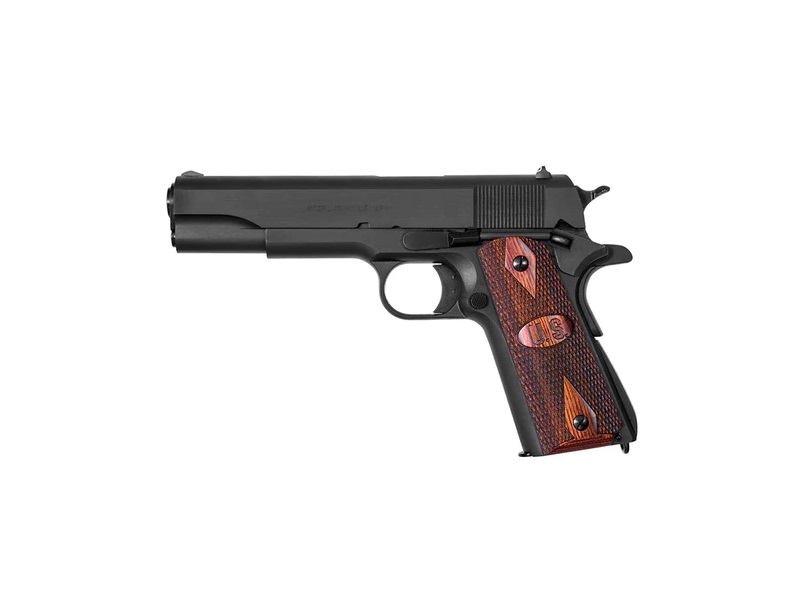
Auto-Ordnance 1911A1 GI Spec .45 ACP 5-inch 7-round
About this product
What is the Auto-Ordnance 1911A1 GI Spec .45 ACP? It is a Series 80, single-action semi-automatic pistol that is a faithful modern reproduction of the final U.S. Government-issue M1911A1 pistol, built to GI specification in a matte black carbon steel frame and slide with a 5-inch barrel. This configuration, with its 7-round magazine capacity, formed the backbone of U.S. military sidearms for over seven decades. As a commercial reproduction, it retains the classic handling and mechanical feel while incorporating modern Series 80 internal safeties mandated for many commercial sales.
What is the Auto-Ordnance 1911A1 GI Spec used for?
The Auto-Ordnance GI Spec is used for historical appreciation, foundational marksmanship training, and as a rugged, no-frills range pistol. Its simple, robust platform and direct trigger mechanics make it an excellent tool for mastering the fundamentals of iron-sight pistol shooting and slide manipulation under defensive pressure. This is not a competition-ready or duty-gun-out-of-the-box; it’s a platform meant to be understood, which is why it serves well as a training tool for shooters working their way up to modern tricked-out 1911s like those from Springfield Armory.
How does the Auto-Ordnance 1911A1 compare to a Springfield Armory Mil-Spec 1911?
The Auto-Ordnance is the more historically correct reproduction, while the Springfield Armory Mil-Spec is the better out-of-the-box shooter. The Auto-Ordnance maintains the original’s low-profile GI-style sights and a standard grip safety, while the Springfield typically ships with a slightly improved sight picture and a beveled magazine well for faster reloads. For a shooter who values historical accuracy and a true ‘blank canvas’ for potential customization, the Auto-Ordnance is superior; for someone who wants a more shootable 1911 from minute one at a similar price point, the Springfield has the edge.
What does it weigh and what are the dimensions?
The pistol weighs 39 oz (2.44 lbs) unloaded and measures 8.6 inches in overall length with a 5-inch barrel. Its height is 5.5 inches from the base of the magazine well to the top of the rear sight, and it has a width of 1.34 inches across the grip safety. This contributes to the classic, solid heft of an all-steel 1911 platform, which many shooters find aids in mitigating .45 ACP recoil compared to lighter polymer-frame alternatives in the same caliber.
Who is this NOT for?
This pistol is not for the shooter seeking a modern defensive carry pistol with accessory rails, night sights, and an optics-ready slide. Its low-profile iron sights are challenging in low light, its manual safety requires deliberate practice to disengage under stress, and its 7+1 capacity is modest by modern standards. It is also a poor choice for a first-time gun owner who is not committed to a regimen of manual safety and slide-rack training, as its operation is less forgiving than a modern striker-fired pistol with a consistent trigger pull.
What's in the box?
You receive the pistol, one 7-round metal magazine, a cable-style trigger lock for compliance, and the owner's manual detailing the Series 80 disassembly and safety system. Auto-Ordnance does not include a hard case, which is a notable omission compared to competitors; you will need to source a suitable pistol case separately, an added cost of approximately $25-$50. For shooters planning frequent range trips, investing in additional quality 7- or 8-round magazines from a manufacturer like Wilson Combat or Chip McCormick is a practical necessity, as seen in our feature on 1911 reliability.
Is the Auto-Ordnance 1911A1 worth it at $767.99?
At its current price, the Auto-Ordnance GI Spec is worth it primarily for the historical purist, the tinkerer, or the foundational trainer. You are paying for authentic carbon steel construction and correct GI specification, not for modern conveniences. If your goal is historical display piece authenticity or you specifically want the exact platform to learn 1911 gunsmithing basics, this is a solid value. If your primary goal is immediate high-performance range time or home defense readiness without further investment, your money might be better spent on a more modernized platform like the Stevens 334 Rifle, which offers a different kind of utility right out of the box.
Specs at a glance
Video review
Pros & cons
What works
- Weighs 39 oz (2.44 lbs) — classic all-steel construction aids in recoil management compared to polymer alternatives.
- Built to exact GI specification — correct profile, sights, and grip safety for historical authenticity.
- Series 80 firing pin block — an added internal safety mechanism not found on original G.I. or Series 70 pistols.
- 5-inch barrel and 8.6-inch overall length — provides a full-sized sight radius and handling characteristic.
Trade-offs
- Low-profile G.I. sights — difficult to acquire quickly in low-light conditions; an upgrade is strongly advised for defensive use.
- Only one 7-round magazine included — requires immediate additional purchase for practical range sessions.
- No included hard case — an oversight at this price point, adding $25-$50 to the total cost of ownership.
- Stiff initial trigger pull — break-in of 200-300 rounds is often required to smooth the factory trigger to a consistent 5.5-6 lb pull.
Expert review
Key attributes
| upc | 602686251136 |
| manufacturer | Kahr Arms |
| manufacturer part number | 1911BKOW |
| action | Single Action |
| atf type | Pistol |
| barrel length | 5" |
| caliber/gauge | .45 ACP |
| capacity | 7 + 1 |
| color | BLAC |
| length | 8 |
| number of magazines | 1 7 rd. |
| package height | 5.0 |
| package width | 8.6 |
| product type | Semi-Auto Pistol |
| safety | Thumb, Grip, Firing Pin |
| shipping weight | 3.65 |
| sights | Blade Front, Rear Drift Adj. |
| sights type | Fixed Sights |
| slide description | Serrated |
| units per box | 1 |
Frequently asked questions
- Does this work with standard 1911 .45 ACP magazines?
- Yes, it is designed to work with standard G.I.-specification 1911 magazines in .45 ACP. However, for optimal reliability with the original magazine release geometry and feed ramp, we recommend magazines from Wilson Combat (#47D) or Chip McCormick (Power Mag). The pistol ships with one 7-round magazine.
- Is the slide pre-cut for a red dot optic mount?
- No, the slide is not milled for a red dot optic. It retains the original 1911A1 slide profile and top serrations. Adding an optic would require having a gunsmith machine the slide, which typically costs $200-$400 and requires re-finishing, or using a less-reliable dovetail mount system.
- How long does shipping take to an FFL?
- Processing time is typically 1-2 business days after order verification, with ground shipping transit adding 3-7 business days depending on the destination. The total timeline from order to arrival at your chosen FFL dealer is usually 5-10 business days. All shipments strictly follow ITAR and carrier regulations.
- Can I return it if I haven't fired it?
- Returns are only accepted for un-fired, unfired, and undamaged firearms, with all original packaging and tags, within 7 calendar days of receiving the transfer from your FFL. A 15% restocking fee applies, and you are responsible for all shipping and insurance costs back to our facility and for initiating a new transfer to your FFL.